
Odds of Being Bored? 1,500% posted 8/8/2025
Susan and I were watching the Phillies – Tigers game on ESPN the other night. I should say we were trying to watch the game since the announcers were spewing out worthless statistics, and at times, more than half the screen was covered by incomprehensible graphics leaving a narrow window of what was happening on the field. Here’s how it went:
Kael: “Good evening! I’m Kael Storm for ESPN, along with Flint Langdon, former pitcher for the minor league Amarillo Armadillos, and Zebulon Quarck, professor of statistics from MIT. Before we get to the starting lineups, Zebby, have you ever played ball?”
Zebby: “I spent 1.367% of my life playing softball in my backyard before being accepted to MIT at age 14.”
Kael: “That doesn’t seem like a whole lot, Zebby.”
Flint: “Yeah. That’s 1,500% fewer minutes than I spent playing ball before breaking into the big leagues.”
Kael: “Uh, Flint, I hate to tell you this, but the Armadillos were only double-A ball.”
Flint: “Well it seemed like the big leagues after 8 years with the Midland Mudhens.”
Kael: “I can see how it might feel that way. But enough about us. Let’s check in down on the field.” A long period of silence. “Well, it looks like we missed the starting line ups and the Phillies already are down to their last out of the inning. There was a 43.674% chance of that happening.”
Zebby: “If you look at that graphic on the right of your screen . . .”
Kael: “You mean where Bryce Harper is supposed to be?”
Zebby: “Yeah. That color smear will tell you the odds of where the next pitch will end up and the lower smear shows where the hitter would like the ball to be.”
Flint: “Oh. I thought those were weather maps showing the storm front looming to the west of us.”
Kael: “Why is that guy walking back to the dugout? Oh! Sanchez struck him out with his ‘slinker.’”
Flint: “I had one of those when I was a kid. It was cool the way it climbed down steps.”
Kael: “Let’s look at our AI-generated replay of that strike out.”
Zebby: “It’s a good thing we have this AI replay otherwise we’d have to look at the actual play as it happened. We could have even seen it in slo-mo. AI tells us the batter’s bat speed was 103.678 mph, and that the pitch was 3.7921 inches below the bat and 1.6893267 inches off the plate.”
Flint: “Looks like he struck out.”
Kael: “If you look at the chart covering half your screen, well, you HAVE to look at the chart since it’s covering your screen, you’ll see that Trea Turner, the Phillies’ first batter, has a 23.6857% chance of barreling up the next pitch with a 36.897% chance of missing the ball.”
Flint: “Is that that blue smudge over on the chart on the right.”
Kael: “No, it’s the first line in the chart covering your screen. The second line tells us what Trea had for breakfast, and the third line is his hat size.”
Zebby: “I like the fourth line where it tells us his stride into the pitch is exactly 6.7834 inches plus or minus 6.7832 inches.”
Flint: “Wait. What’s going on down below us? Is that some crazed fan running the bases?”
Kael: “Uh, no, Flint. That’s Trea heading for second on that ball he scooted down the first base line. Let’s look at the AI-generated replay of that hit since we actually missed calling the play.”
Zebby: “You’d think the AI replay would have better resolution. It looks like an old Clutch Cargo cartoon.”
Kael: “We could bring up the actual replay but we already missed Kyle Schwarber’s home run while we were watching the cartoon.”
Zebby: “But we can tell you that the odds of that Schwarber home run happening were 3.56789 to 1, the exit velocity was 114.397654 mph, the lift angle was 29.574736 degrees, and the distance was 414.7695 feet. It would have gone further if it hadn’t knocked the can of Yuengling out of a surprised fan’s hand. The odds of that happening from Take Your Money Kings were 578.9346 to 1. It also would have gone further if he had barreled up better instead of the ball missing the center of the bat by 15.34729673 microns.”
Kael: “Flint, you were a pitcher. Can you explain that pitch that Morton threw that left the park?”
Flint: “Be happy to, Kael. Charlie Morton’s been around the diamond a long time, so he knows to grip the ball with his fingers. When he grips the ball with his fingers and throws it towards the plate it has speed and it spins. Plus, it stays in the air for a long time. Then he just prays it goes over the plate in such a way that the batter misses it. Kyle didn’t.”
Kael: “With that kind of technical expertise, I’m surprised you never made it to the majors.”
Flint: “Yeah. Me, too. My parents were kind of bummed.”
Zebby: “When you were drafted, I calculated that you had a 5.7835742% chance of making it to the big leagues, so I wasn’t surprised at all.”
Kael: “Well, I know it’s hard for you people watching at home to see, but from what I can see up here, the game’s over. Just 2 hours and 5 minutes. For those of you with bets down, the odds of the game ending that quickly from Take Your Money Kings were 56.7834 to 1. So, to wrap it up, one team won and the other lost. Until next time, for Zebby, Flint and the whole broadcast crew, I’m Kael Storm.”

The Dreaded Procedure
(That for your own good must be endured)
Earlier this week, my wife, Susan, was scheduled for a colonoscopy. Now, the procedure itself is no problem; most people are knocked out by a friendly anesthesiologist before things go the wrong way up your rectum. I felt sorry for her not because of the colonoscopy itself, but what happens during the preliminaries, the “prep” as it is called.
Susan said, “It doesn’t sound so bad. I just have to drink these two five-ounce bottles of Drano, one 24 hours before the procedure and one 5 hours before.”
Okay, it wasn’t really Drano. You can’t buy this stuff over the counter, so you need a prescription for it. That way, they (the big Pharma people with a sense of humor) can give it some sort unpronounceable name, like Xboweliziquinivoque. Susan also explained that nowadays they seem to be taking a more holistic approach.
“One week before the procedure,” she said, “you must stop eating.”
I interrupted her at this point. “Really? Stop eating for a week?”
“You didn’t let me finish,” she said. The “as usual” was implied but not said. “You can’t eat popcorn, corn, beans, nuts, fruits with small seeds, tomatoes, and celery.”
Okay, some of that was redundant. Corn and popcorn are the same thing, except that popcorn has more of a cardboard texture, especially if you buy it already popped in a bag. Fruits with small seeds and tomatoes are the same thing since, as everybody knows, tomatoes are fruits. I really thought the dietary directions could have been more explicit since I was about to grill some zucchini for dinner that night, a fruit with small seeds. My famous eggplant parmesan? Nope. Maybe they just thought nobody would eat eggplant to begin with.
The ban on celery I could understand. Celery is just strands of fiber of no nutritional value that are totally indigestible and I’m sure the ass doc doesn’t want them getting all tangled up in his scope. Now, I used the term “ass doc” because one time when I was in Annapolis, a beautiful two-masted schooner was tied up at the main dock. As I walked down the dock admiring this incredible craft, I was wondering, “Who can afford something like this?” I got my answer when I reached its stern and saw the name of the boat. Prominently displayed there was “Ass Doc.”
I had to admit the prep Susan was going to do sounded MUCH better than what I had to do the last (and final) time I had to get a colonoscopy. I added (and final) there because I’m apparently too old for them to bother with it anymore.
The directions I received back then (about ten years ago) were to go into a pharmacy like CVS to buy what I needed. My doctor said, “Don’t use the pharmaceutical section of your grocery store, because they won’t have enough different kinds.” That put a scare in me. He continued. “Buy a box of every kind of laxative they have, then 24 hours before the procedure, take five times the recommended dose of each one.” That REALLY put a scare in me. FIVE TIMES!?!? All of them!?!? But he wasn’t finished.
“You’ll also need to buy five 32-ounce bottles of Gatorade. Not the red or blue kind. It has to be yellow or phosphorescent green.” I noticed that he simply referred to the Gatorade by its color since the flavor on the label has NOTHING to do with how it tastes. He still wasn’t finished.
“Now, this isn’t totally necessary—just recommended. Go to a Pep Boys or Autozone. Buy a replacement seat belt for your car.” My car didn’t need a seatbelt, and I told him so. He laughed.
“It’s not for your car; it’s for your toilet seat.”
Remember those plastic toy rockets you had when you were a kid. You’d fill them halfway up with water and then pump them full of air. When you couldn’t force any more air into it, you’d release the latch holding it in place and it would zooooooom up into the air like, well, a rocket, spewing all the water out behind it. With “behind” being the operative word, that’s the image I had in my head for what this quack had in mind for me because all that Gatorade was going to have to go somewhere. Sooner rather than later, in all likelihood.
It was a good purchase.
So, you’re probably saying to yourself, “Why is all this torture necessary?” I always believed that it was so the doc would have a nice clear view of everything, and this is partly true. It’s also so that there’s nothing left in your bowel to produce methane gas because if the doc needs to snip a little polyp off your intestinal wall, after the snip he needs to cauterize the wound with a little electric zapper. Methane gas and an electric zapper (that is the technical term, by the way) do not go well together. In fact, you could end up with an explosion occurring in your gut.
I am not making this up. This takes the expression “explosive diarrhea” to a whole new level.
(Just as an aside, every time I have to write “diarrhea,” which thankfully is not too often, I have to look up how to spell it.)
In medical terminology, an explosion in your gut is known as a “bad thing.” In fact, it can be fatal. I noticed in the instructions Susan received it said, “If you have a living will, be sure to bring it with you.” This does not inspire confidence.
So, the clever medicine people figured out that to help prevent this explosive event from happening, they can pump a non-explosive gas up your rectum. Remember the rocket? This also inflates your bowel like one of those long balloons used to make dachshunds at a kid’s birthday party, making it easier to thread the looooonnnngggg scopey thingy (I know, more medical terminology) up and around all the corners in your gut.
Let’s see. Inert gases are non-explosive. Thinking back to your high school chemistry, probably the first inert gas that comes to mind is helium, plus it’s also used in balloons. So, they tried this, and while it prevented explosions—you know what it sounds like when you inhale helium and then try to talk—the long farts that occurred after the procedure was completed sounded like someone holding the nozzle of a balloon to get a high, irritating squeaky noise as the air escapes. The other problem was that if too much gas was used, the patient began to rise up off the operating table.
Much of that last paragraph is not true.
As we drove home from the procedure, I asked Susan what gas they used. The music was loud in the car and I thought she said, “Hydrogen.”
“Hydrogen?” I asked. “HAHAHAHA! Remember that Hindenburg film?”
She said, “No, I said nitrogen. Turn down the music and get your ears checked.” She says that to me all the time, but we thought nitrogen was a good candidate. To check it out, when we got home, I Googled it.
(Another aside: Does “Googled” need to be capitalized or has it become like “kleenex?”)
It turns out that good old CO2 is what gets pumped in. This has me concerned. What with all the colonoscopies done every day in that one clinic, then if you multiply this by all the clinics operating all over the country, all over the world (!) could it be we’ve discovered what could REALLY be the cause of global warming?
Final words, if you are of a certain age: “Git ‘er done!”

Pennies from Heaven—or—Trump Doesn’t Make Cents Posted 2/24/2025
“Every time it rains, it rains pennies from heaven,
Don’t you know each cloud contains pennies from heaven?”
So much for that song! Heaven is letting us down! Well, it’s really the U.S. Mint since it is likely that they will be stopping penny production. And it’s about time. For years it has cost more to make a penny than it’s worth. There’s something perversely stubborn about that. The other perverse thing about the penny situation is that I’m forced to agree with a Trump decision. Of course, the decision was a no-brainer, which is the reason he was able to come up with the idea.
The disappearance of the penny has been gradual. Its march to oblivion began when the cost of a penny candy hit a nickel. The only thing pennies are good for now is to put into rolls in paper wrappers then stuff them in a sock to create a makeshift blackjack. Very useful, indeed.
With the demise of the penny will come the loss of other iconic pieces of Americana, falling like dominoes in a TikTok video. Say goodbye to the penny loafer and a fond farewell to the stupid machines in arcades that flatten a penny into an oblong keepsake. They gave a whole new meaning to stretching your money.
The penny’s inevitable extinction was as predictable as the fate of the dinosaurs once the Flintstones learned to eat them rather than keep them as pets. However, its eventual demise got me thinking about other things that have disappeared in the course of my lifetime.
Bunyips. Yes, this is the first thing that came to mind after pennies.
What ever happened to Bunyips? People of a certain age who grew up in the Philly area will know what a bunyip is. As children, we saw them all the time. One, in particular, could be seen on a regular basis on TV hanging out with Lee Dexter and Sir Guy de Guy. Mr. Dexter was an Aussie ventriloquist who neglected to mention on his show that a bunyip was a beast from Australian Aborigine folklore that hung around in swamps and marshes devouring unsuspecting fans looking for an autograph. In the Wergaia language it translates to “devil” or “evil spirit,” perfect for entertaining young children on a Sunday morning. Perhaps it was to drive people to go to church. And is it a coincidence that at the same time Bertie the Bunyip disappeared, Lee Dexter vanished as well? I think not.
Pluto. Not the dog, the planet. Although as far as I’m concerned, the whole panoply of Disney cartoon characters could have disappeared, and no one would have cared. Donald—not funny. I’m talking about the duck here, not Duck a l’Orange. Mickey—not funny, either. Compared to Disney cartoons, people actually laugh at Looney Tunes characters like Bugs, Daffy, the Martian, and Wile E Coyote. How could you not? What’s funnier than getting crushed by an Acme anvil? Or being hit by a train that steams out of the painted-on entrance of a railroad tunnel?
And there was something very strange going on around Mickey. Why did Goofy (a dog) wear clothes and talk while Pluto (another dog) ran around stark naked and couldn’t say a word? I think when the Disney cartoonists created these canines, they were feeling some of the residual effects from the drugs they took to create “Fantasia.”
Oh, wait, I’m being told that Goofy and Pluto were created before “Fantasia.” So much for the drug theory.
Back to Pluto the planet. What the hell happened? First, you’re a planet, and then you’re not, and then maybe. That’s pretty damn rude, I think. Its status as a planet has been argued back and forth amongst astronomers who apparently have nothing better to do. It’s sad to see our ninth planet (well, maybe) treated like some celestial yo-yo. As it turns out, there’s another “planet” lurking in the Kuiper belt—not to be confused with Kuiper’s slacks or Nehru jacket—that is BIGGER than Pluto. It goes by the name of “Eris,” and some want to call it our tenth planet.
So what? Get a life.
Oldsmobiles and Pontiacs. I’m not going to include Edsels or Corvairs in this category since they didn’t last long enough to have any permanence in my life. However, when I was growing up, we had an Oldsmobile 88—red body with a white top. It was hideous. A great blob of molded steel waiting for the advent of fins on cars. This is not from memory. I found a picture of one on Wikipedia. However, our family went all over the East Coast in that car—fond memories. The first car I ever bought was a Pontiac Firebird. Red, of course. It was the first year they came out and it went all the way to Hawaii with me. No, it was not an amphibious car.
The question is, why did General Motors get rid of these iconic vehicles (think of the Olds 442 and Pontiac GTOs) and keep your grandmother’s car with a name that sounds like someone losing their lunch? That’s “Buick” for all you non-car afficionados. People fell asleep just looking at a Buick.
There are some things that have disappeared that really needed to disappear, such as all the toll booths on the Garden State Parkway. They were spaced every quarter mile so that you had to slow down to throw a quarter into a basket, creating massive backups of vehicles jockeying for position like people trying to get in the quickest line at the supermarket. The problem was an almost 2-ton vehicle packs more of a wallop than a grocery cart. What masochist came up with that idea? Probably the same person who invented speed bumps.
So, these are just a few of the things that popped into my head when I heard about the current currency dilemma. If you think of any other things that have faded from the scene and had meaning for you in some way, feel free to let me know.
Penny for your thoughts.
Food Names – Posted 1/5/2025
Susan and I were walking our dog, Jesse, down by the docks of the marina near our house. We stopped and were trying to decide whether to walk around the marina on the decking or to stay on the street. Walking on the lawns bordering the streets is easier for Jesse; she’s over sixteen and has arthritis. I was worried the decking would be too “slippery” for her. Eventually, Jess made the decision. The wooden planks called to her, that and a wet spot of dog urine just a short dog sniff down the ramp. At least I assumed the spot was canine in origin. One never knows.
As we walked down the ramp, a small plastic bag was billowing in the cold winter air that swept across the marina, yet it wasn’t blowing away. When we got down on the decking, we could see inside the bag and discovered it was anchored in place by a pair of deer feet. The feet were not connected to deer legs; they were inside the bag all by themselves. They seemed quite lonely, lost, even, as if they were looking for something. Probably the rest of the deer, was my guess.
As with the dog pee, I made another assumption that some hunter had killed the deer, and after butchering it, found there was no more room in his trash bin for the leftovers that didn’t earn a space in the freezer. So, he bagged the feet and set them to be on display at the entrance to the marina.
I know, I know, that’s just not very logical. But then again, look how our election turned out.
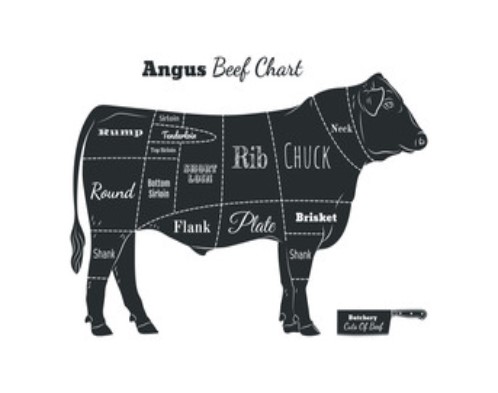
Anyway, the stuff that made it into the freezer is no longer deer; it’s venison. Just as cow that is in our freezer or on our plate is called beef. No one says, “Hey, why don’t you and the missus stop by later this afternoon, and we’ll throw some cow on the grill.” If it’s really good cow it gets a French name so it can be more expensive: filet mignon. Sometimes, it gets a little disgusting, as when it’s named after a specific area of the animal. I never could work up an appetite thinking about rump roast for dinner. Then there’s veal. If it’s a baby cow it has to have an entirely different name. There is no cow scallopini or cow saltimbocca.
When did this all start? On the Serengeti Plains? Perhaps it went something like this.
Person 1 (they didn’t even have names for themselves yet) to Person 2, “I can’t eat something called ‘wildebeest.’ That’s disgusting.”
“Why is the word ‘wildebeest’ disgusting?” Person 2 replied. “In fact, just as an aside, it hasn’t even been coined yet.”
“I don’t know. It just is.”
“Well, if you want to change it to something else, I have no beef with that.”
And so, the first food re-naming came to pass.
It caught on. Other foods fell into this renaming game, such as pork. A fine restaurant won’t have a description of a perfectly grilled pig chop on its menu, or pig intestines stuffed with more ground up scraps of pig along with other stuff served over a bed of fettucine. Curiously, no one has roast pig for dinner UNLESS YOU ROAST THE WHOLE ANIMAL.
That brings me to leg of lamb and lamb chops. I always thought it was sort of weird that Shari Lewis named her cute sock puppet after a cut of meat. What was she thinking? She probably had a puppet that she never brought to life called “Tripe” hidden away in a cedar chest somewhere in the basement. Now, lamb is actually what we call a baby sheep, but we had to come up with a new name for eating old sheep (which we here in the New World don’t): mutton.
Please notice there is a trend here. Except for lamb (and goat), all the name-changing applies to mammals. For lowly invertebrates like crabs, lobsters, clams, or oysters, there’s no need to cover up the actual origins of that protein. They don’t even look appetizing. Crabs and lobsters resemble large mutant aquatic insects, and the inside of that rock-like thing called an oyster looks suspiciously like a giant booger.
Yes, I eat all of them.
Stepping up (evolutionarily speaking) to the vertebrates, fish don’t stand a chance. Of course they don’t stand a chance; they don’t have a leg to stand on. Haha! Yes, I used that joke and I’m proud of it.
Apparently having legs isn’t good enough for some name concealment since we don’t feel the need to disguise our food if it has wings. We roast whole duck, we cut off pieces to have duck breast or duck legs. Again, the French make this sound a lot better, such as “magret de canard” or “confit.” Those French have a different name for everything.
We eat roast chicken, chicken legs, chicken breasts, chicken thighs, and Buffalo wings. Wait, how did that get in there? For dim sum in Chinese restaurants, they even serve chicken feet! Do people know what chickens walk around in? But, you say, “There is no meat on feet!” So, I say, “Do not eat feet when there is no meat.” It’s a sort of Dr. Seussian philosophy.
Speaking of feet, as with the English language, there are always exceptions to basic rules. Earlier I said that we only call it “pig” if we roast the whole animal. But I do know that there are certain people in this world who view pig’s feet as a delicacy. Again, I’ll ask the question, do people know what pigs walk around in?
Rabbit is another exception, but then again, not that many people eat cute little bunnies. If rabbit is on a restaurant menu, I doubt very much that it would be described as “bunny sauteed in a creamy mustard sauce.” However, there are those who view keeping a dead bunny’s foot in your pocket as good luck. As the old joke goes, but not for the rabbit.
So, for this discussion, we seem to have come full circle. Started with feet and ended with feet. I guess all the arguments about food names have been defeeted.
The Portugal Trip (Part 2) – Posted 12/13/2024
Okay, I admit that I knew nothing about port before going to Portugal. I’m talking about the beverage here, not something like Pearl Harbor. I know plenty about the port in Hawaii. I did know there were tawny ports and ruby ports but that was the extent of my knowledge. The only other thing I knew was there was a song Brian and I used to sing called “White Port and Lemon Juice” by the Four Deuces that came out in 1956. In the tasting room of the vineyard Quinta Santa Eufémia in the Douro Valley, a young man was telling us about the kinds of port they produce as we tasted them. I told him about the song and suggested they should play it as visitors sampled the wines in their tasting room. He told us to leave. Not really. Not surprisingly, he had never heard of it, so I sent them a link to the song through the contact page on their website. I haven’t heard back. Not holding my breath.
Port became our drink of choice as we traveled throughout the country, and we always kept a bottle of white port in the fridge of our condo (until it was empty) and perhaps a nice, aged tawny for after dinner. A “digestif,” if you will. Very civilized. That’s us. Every time Gilles or I would buy a bottle, Susan would say something like, “Another bottle? We only have four more days here. We’ll never finish it.” HAHAHAHA!
Another product synonymous with Portugal is sardines. They’re in every restaurant, featured in artwork, especially ceramics, and there are more than twenty stores all over the country that deal exclusively in sardines: The Fantastic World of Sardines or “O Mundo Fantastico das Sardinhas.” If you are familiar with the M & M’S World store in New York City, then you’ll get the concept of an entire store filled with canned fish. Well, maybe not. However, you don’t have to go to Portugal to experience the sardine extravaganza. There’s now a “O Mundo Fantastico das Sardinhas” in Times Square, NYC. Of course there is.
Sardines are woven into the fabric of everyday life in Portugal, literally and figuratively. We brought home a dish towel with colorful sardines embroidered right into the fabric. Sardines are mentioned in songs and in quaint expressions, such as “A mulher e a sardinha querem-se pequenina,” which means, “a woman and a sardine are meant to be small.” It reminds me a bit of Kipling’s statement, “A woman is only a woman, but a good cigar is a smoke.” Well, maybe not quite the same.
Now, before you blurt out, “A mulher e a sardinha querem-se pequenina,” at a cocktail party in an attempt to sound sophisticated you need to understand that it has something to do with smaller sardines being more tasty than larger sardines.
I think it’s time to move on to another topic.
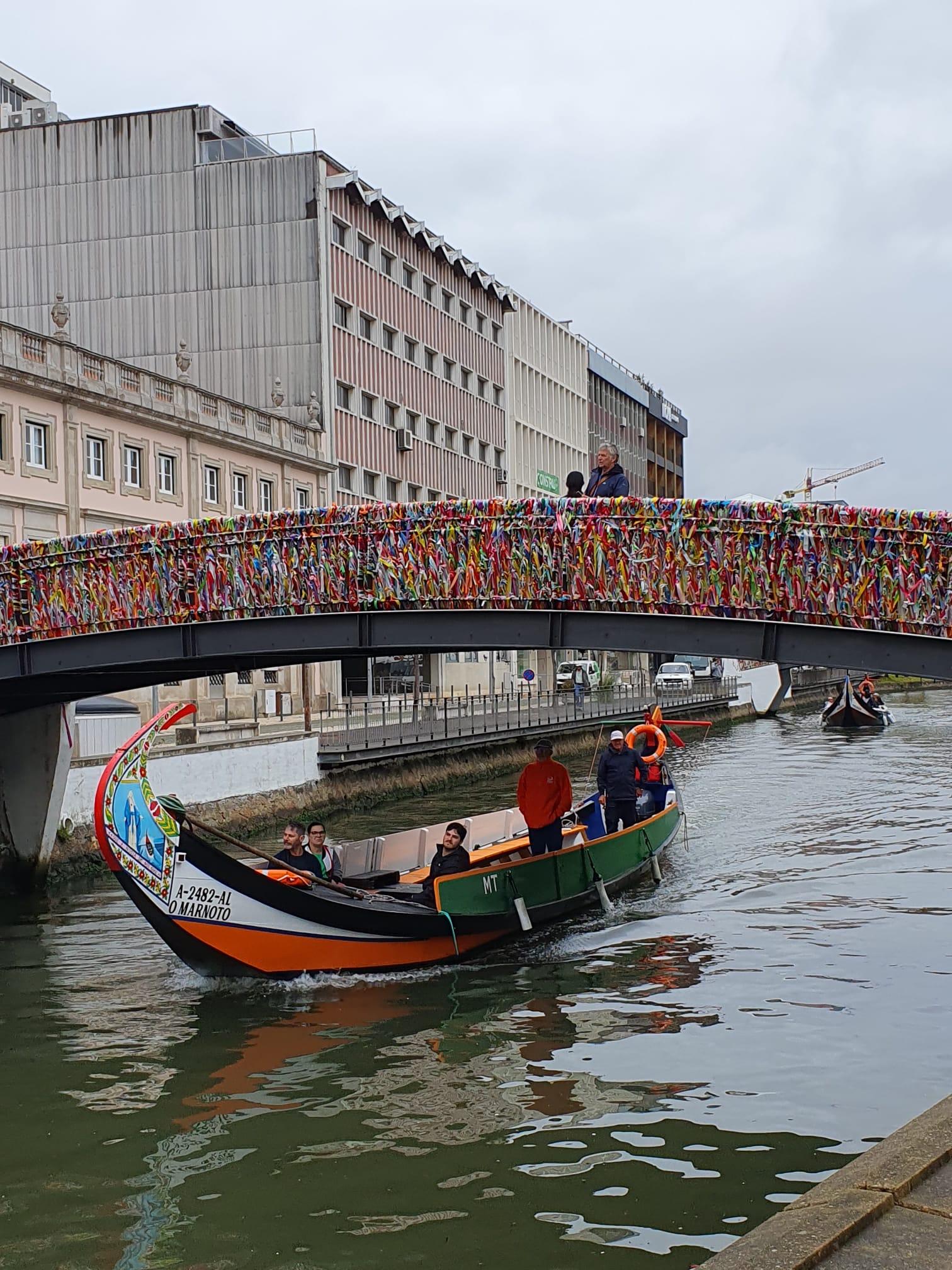
Just south of Porto along the coast is Aveiro, the Venice of Portugal. Like Venice, it does lie below sea level, but the canal system is nowhere near as extensive. It’s drained and refilled daily by a main lock that is open and shut based on the tidal cycle of the ocean to keep the water fresh. It was surprisingly clean. The main canal near the center of town is spanned by an old wooden bridge, the Ponte dos Laços da Amizade or Bridge of Friendship Ties. It is said that if each of two people tie a ribbon to the bridge their friendship will last forever, unless one of them comes back later and takes theirs away, thus divorcing the other person.
Actually, I just made up the last part. Our guide on our “moliceiro” (canal boat) said that at one time the ribbons were so numerous that they had to be removed because it was feared that the bridge would collapse under their weight. When that was done, heated arguments broke out all over the town as a result of the broken friendships. Not really. In fact, our guide doubted that the removal of the ribbons ever happened.
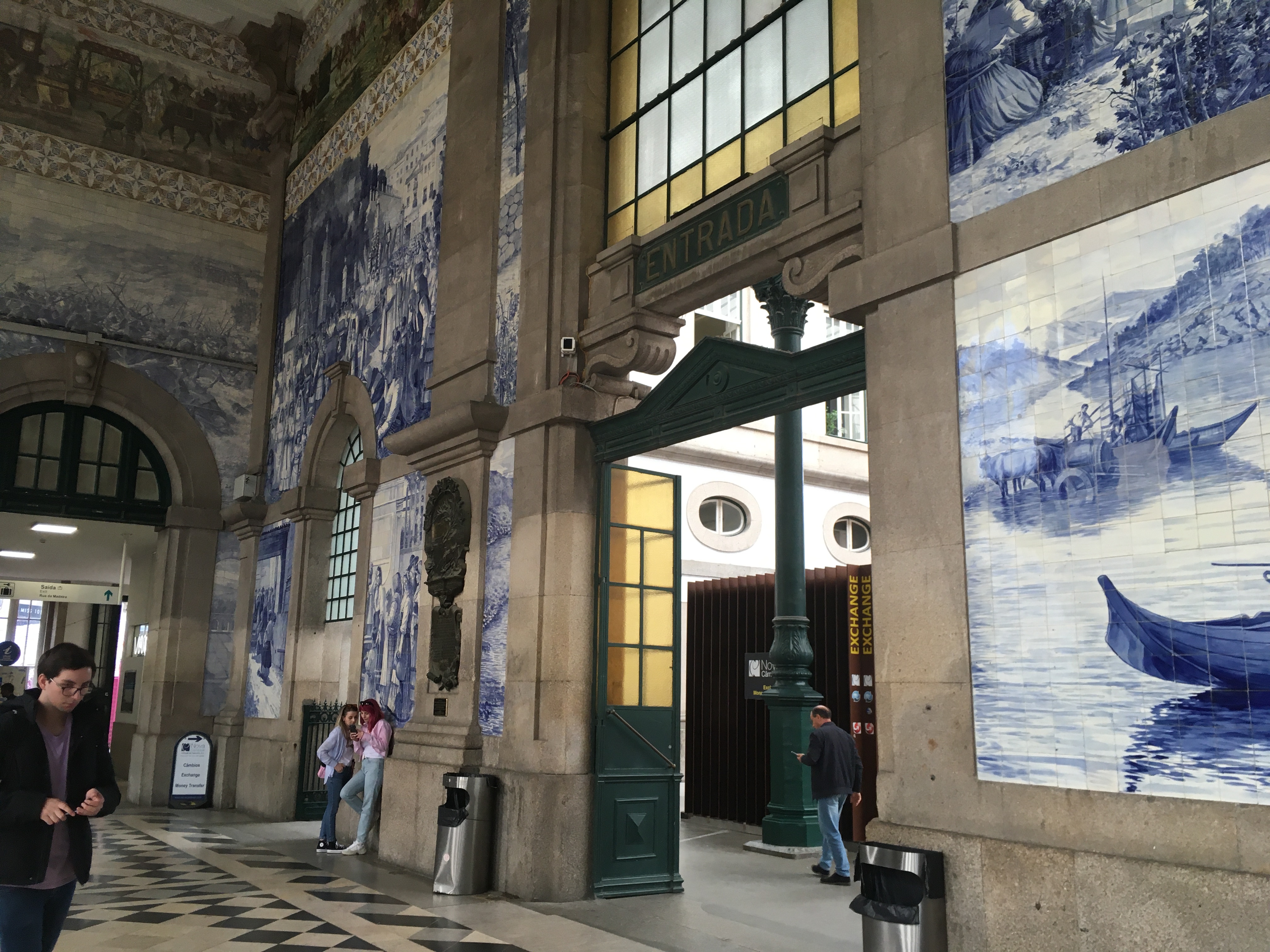
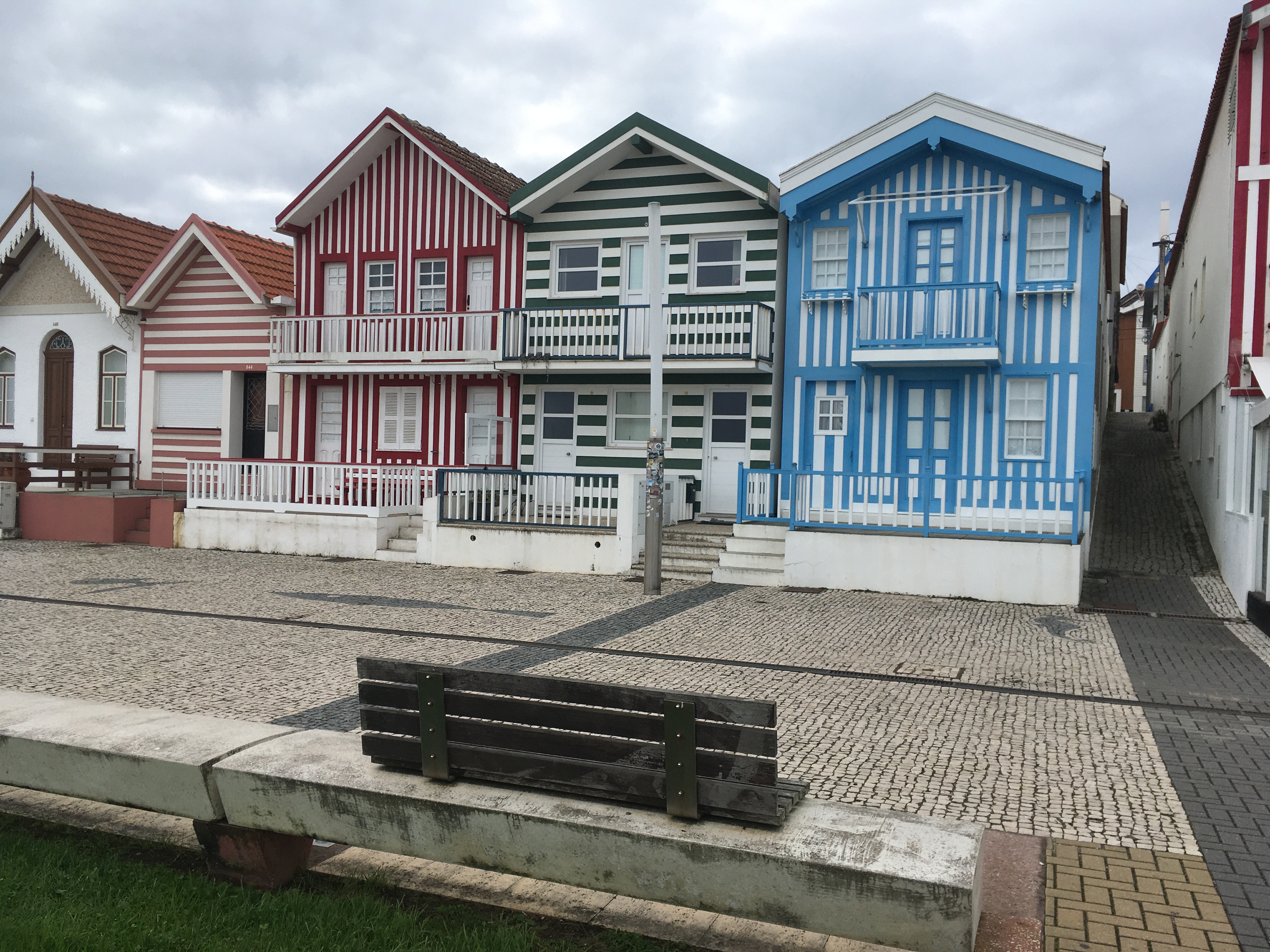
There are many styles of architecture in Portugal, and many of the buildings feature beautifully tiled walls, both on the exterior and interior. One of the pictures shows the inside of the train station in Porto. However, the people in the coastal town of Costa Nova apparently didn’t get the message. The homes lining the bay there are painted with broad vertical or horizontal stripes in very bold colors (see picture). Each home is unique, supposedly so fisherman returning from the sea after hunting the wily sardines could locate their house. It’s also easy to find your house after returning from the pub after an all-night binge.
As I was looking at the houses, I was wondering what the HOA had to say after the first person painted their house in stripes. I found the following in my research.
The president of the HOA said, “Um, look here, Vasco, I know you think you’re a trend-setter and everything, but this paint job is just not working for the neighborhood. Either slap some decorative tiles over this or we’re going to have to fine you.”
“Oh, sim,” said Vasco, which is Portuguese for “Oh, yeah!” “In that case, I’m taking my sardine boats to India to find spices instead of fishing for these stinking, oily little fish.”
Vasco sailed and sailed, and then sailed some more all the way around the Cape of Good Hope where he discovered India, even though there were already people living there. “Há!” (Portuguese for “Ha!”) Vasco said, to no one in particular. “I discovered the real Indians. Wait until old mister smart ass Christopher hears about this! That’ll take the wind out of his sails.”
He returned to Costa Nova with cinnamon and other exotic seasonings to make pumpkin spiced lattes which apparently were extremely valuable back in the day since there weren’t any Penzey’s, McCormick’s or Starbuck’s. With the money he made, Vasco bought up all the houses and painted them to create the most garish display to be found in all of Portugal.
Vasco said to the president of the HOA, “Então aí,” which is “So, there,” in Portuguese. “E já agora, já não é o presidente do HOA,” which means, “And by the way, you are no longer the president of the HOA.”
That’s what I found on Wikipedia, anyway.
The Portugal Trip (Part 1) – Posted 12/7/2024
To get to any destination in Portugal, you need to go uphill, especially in the cities of Porto and Lisboa. Now, I understand this defies the law of physics that what goes up, must come down, but it sure didn’t seem like it when I was on foot. The uphill treks I endured were far greater in number, distance, steps, whatever measure you choose than the number of descents. And even some of the descents weren’t decent.
Yes, I’m sure of it. I know what I’m talking about. I was there.
It reminded me of the kind of thing my father used to say about how he got to school. “You think you have it bad standing in the rain waiting for a school bus. Why, when I was a kid, we had to walk to school through two feet of snow, uphill both ways.” If it wasn’t for the “snow” part, I’d swear my father grew up in Portugal. And, yes, I DID think I had it bad waiting in the rain waiting for the school bus. Scarred for life.
In any event, the Portuguese have managed to locate everything high up on cliffs that can be reached only through a great deal of physical exertion or by spending money on some conveyances that look as though they belong in an amusement park. These modes of transportation have funny names like the “Teleférico de Gaia” or the “Funicular of Nazare.” I’m telling you those Portuguese (and French) have a different name for everything over there.
I was in Portugal with my wife, Susan, and her sister Kristin and her husband, Gilles. Kristin and Gilles live in France and had been to Portugal, so they’re used to this sort of nonsense. Kristin also likes to walk a lot. Susan got caught up in her fervor for traipsing about the towns. “Oh, it’ll be fun,” she said.
(Please look up the phrase, “It’ll be fun,” in my story “The Boston Trip” for some context. “Blogs” at jack-bartley.com.)
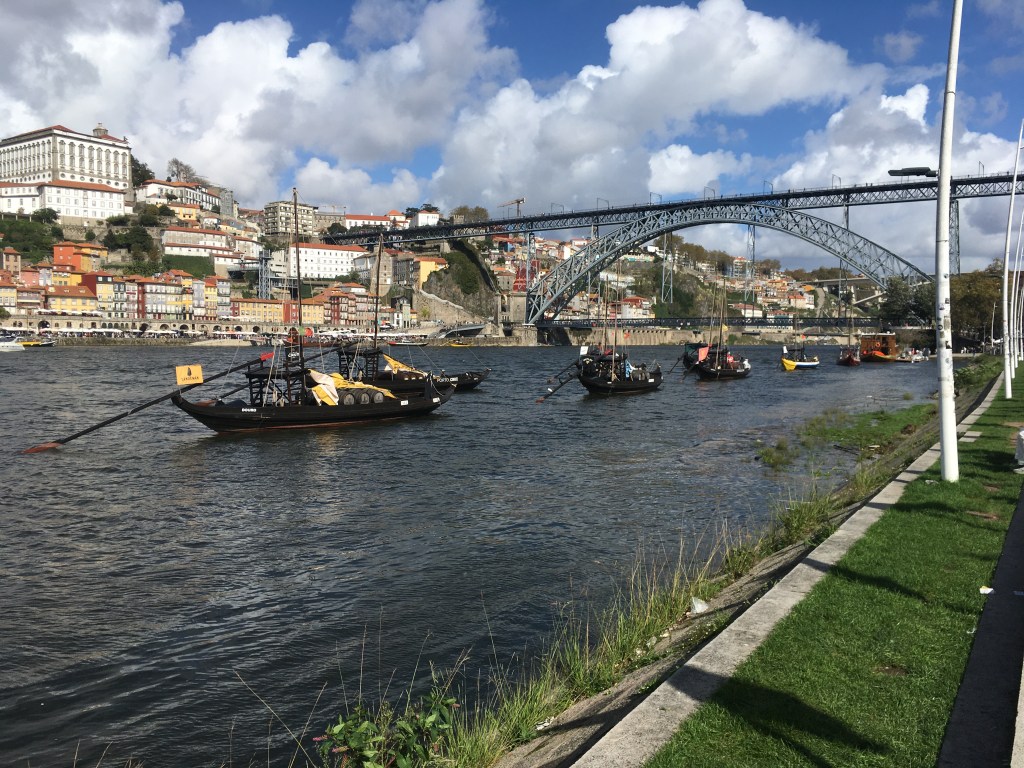
We rented a townhouse close to mouth of the Douro River and could see Porto glittering in the morning sun like Camelot high upon a cliff and far beyond our reach. We decided to take the Teleférico de Gaia to scale the more than 200-foot ascent, but first we had to walk 20 miles to get to the departure site. Okay, it wasn’t really that far, and we did get to see some nice dead mullet floating in the river.
The Teleférico de Gaia is really just a gondola with a fancy name, but it does provide an incredible view of the river and the city on the far side of the river. It deposited us at the end of a bridge that spans the river, so of course we had to walk across that to get to the other side, just like the proverbial chicken. The views were tremendous, and we were up so high I couldn’t even see the dead fish. There were lots of photo-ops, but you had to make sure that you weren’t run over by the tram that runs back and forth on a pair of tracks while posing for a good shot.
Once on the other side, we consulted Gilles’ GPS to see where the cathedral was. Yes, we were going to see a cathedral. It’s what you do when in Europe. It was very close by, UPHILL to our left. As it is with virtually every cathedral I’ve been to in Europe, it was an impressive structure filled with statues, stained glass windows, beautiful pieces of art, and high arched ceilings that must have kept thousands of serfs off the streets for many years during its construction. I must admit, it makes most of what we throw together for buildings look pathetic.
Our next destination was a huge market in the center of town. My favorite place to go when visiting a new place is a grocery store or market, especially if it’s an open-air affair. Nothing tells you more about people than what they eat, and the Portuguese really know how to eat. It was a long walk and there was a lot of construction near the train station that we had to avoid. And, yes, every detour we took was uphill. We wandered through the open section of the market, but a downpour forced us to a section that was under-cover where we found a nice restaurant featuring lots of different menu items besides the Big Three: Sardines, Cod, and Squid.
As I said, the Portuguese really know how to eat, and drink. We commented to our waiter about the huge portions of food that were served to us in restaurants and the fact that everyone had wine or Super Bock, the ubiquitous Portuguese beer, with all their meals. Our young waiter explained, “We eat for strength, and we drink for inspiration.” He was obviously referring to navigating all the hills to do even a simple errand. Now fortified, we were ready for our next jaunt: to see a castle.
A castle is a big draw for tourists in Europe. This is especially true for people from the United States since we don’t have any castles, except perhaps in the Magic Kingdom. And that doesn’t count. The castle was on the other side of town, which of course, was uphill from the market. When we arrived, we discovered that not only was it uphill to get to the area of the city where the castle was located, but the castle itself was perched high atop a hillside with a terraced cobblestone street leading to its entrance. Now, I said it was terraced. Normally with a terraced hillside, there are flat sections (where you can catch your breath while you pretend to take in the magnificent scenery) and steep sections which are the cause of having to catch your breath while pretending to take in the magnificent scenery. On this particular street, the terraced sections were steep, and the uphill sections were steeper. *sigh*
We stared at the sloping cobblestones for a while, then Susan said, “We’re here now, we have to go up. It’ll be fun.” There’s that phrase again.
Just a short way up, Kristin (you remember Kristin; she’s the one who likes to walk), Kristin says, “I’m done. Count me out.” And with that, she parachuted back down.
Okay, the parachute was an exaggeration.
Susan, Gilles, and I bravely marched onward and upward, and when we got to the top, there was nothing in the castle but an art gallery with some paintings by local artists. What?!?!? There was more castle above the gallery, but the entrance was blocked off. Perhaps you had to buy a picture to explore any further. There was a nice view from the low stone wall that surrounded the castle’s small courtyard. We were so high up that by looking over the wall towards the east we could see our house in Delaware.
Not really.
So, we started back down. Please note that in three pages of writing that is only the third time I’ve used the word “down.” And if you’re keeping track, that last one doesn’t count towards any future tallies. However, even “down” is difficult when walking on cobblestones, steeply pitched cobblestones, mind you. And then, about halfway through our return journey, we saw him. A mailman. On foot. Marching uphill and dropping letters and bills through slots in the doors of the houses that lined the terraced street. And not far behind him, two old ladies were trudging upward toting what appeared to be heavy shopping bags, more than likely filled with bottles of Super Bock and tawny port. Everyday life on the hills of Porto.
I guess our waiter spoke the truth.
The Reunion – Posted 11/23/2024
I went to a high school reunion last week. It was nothing special, and by that, I mean it wasn’t a “biggie” like fifty or sixty years. However, it was SPECIAL in that I got to hang out with some of my favorite people in the world, some of whom I’ve known since I was five years old. We simply didn’t want to wait the interminable five years between the standard reunion times. That, and we’re getting on in years.
It’s hard to pin down what it is about the Radnor High School class of ’67, but many of us are drawn together simply to enjoy each other’s friendship. I’ve never been to a college reunion, although I should get back just to see some of the people from the radio station, and I’ve never been to a ship’s reunion from my time in the U.S. Navy, even though we shared some trying, but also fun, times. “Strong it is, the high school bond,” said Yoda.
Many of us stayed at a local hotel (Embassy Suites Valley Forge), one that we have used before for our gatherings. A few of us had to travel to share in this experience, and it was very accommodating of the hotel to permit our friends living locally to drop by for a drink at happy hour, a group dinner, and breakfasts. Thanks to Larry, Maya, and Betsy for organizing things.
There is a certain “core” of my friends, the “usual suspects,” who show up at these events all the time, and I’ve tried to pin down what it is that unites us so. My first thought is having a good sense of humor. To survive at Radnor, you had to be able to give, as well as receive, rather sarcastic and sharp commentary from those around you. It was a way of life; I didn’t think much of it at the time. That is, until we made Mrs. Yoder, one of our high school math teachers, cry because she thought we were being uncommonly cruel to each other. I forget who went to the board to solve a problem (it could have been me), and then had the misfortune of doing something stupid while standing in front of a bunch of comedians ready to pounce. And pounce, they did.
Mrs. Yoder through tears, said, “How can you treat each other like this? This person is trying to do their best, and all they get is criticism. Can you imagine what it must be like to be the target of this sarcasm?”
Well, yeah. We all grew up together. It was expected. It would be a disappointment not to be taken to task. Stunned, we looked around at each other to confirm that what we were doing was normal, at least to us. We tried to explain to our teacher that this is what we did on a daily basis, but I think, to no avail. To be the recipient of jabs and japes meant someone cared enough about you to take the time to hurl comedic insults in your direction
Now, there are some of my friends who are reading this, and thinking, “I didn’t make sarcastic comments about my fellow students, my friends.” And you didn’t because you were genuinely nice and would not hurt someone else’s feelings. This is not to say that you didn’t have a sense of humor, it was just that laughter didn’t have to come at the expense of another. There are many people like this in the world, and as I moved on from high school, I discovered that I had to self-censor my brain and tongue because I was in the company of individuals not conditioned, hardened as it were, to the wit and wisdom of clever humorists.
I missed that. Throughout my travels since graduation, I have come upon small, clandestine pockets of such comedians: in college, in the navy, in the Philly Folksong Society, definitely amongst high school teachers, and of course, my wife, Susan. She’s brutal. Our ilk are drawn to each other, moths to the hot flame of sarcasm.
But, as usual, I digress. One of my favorite parts of a reunion is to see who shows up unexpectedly, someone who has not been to many, if any, of the other gatherings. Not one of the “Usual Suspects.” There were several this time (Charlotte, Ellen, Linda), but one friend showed up, Dan, who had only attended Radnor for a couple of years in junior high. He had wanted to come to previous reunions, but the dreaded “work” kept him away. It was great to see him and find out where life had taken him. We had been on separate journeys but our final destinations were very similar.
In addition to the humor (he said, getting serious), one thing that comes through is a genuine caring for each other; there’s a desire to see our fellow classmates be happy. Over the years, many of my friends “found” each other long after graduation, and married. For that, I am truly glad. Sometimes I’m amazed, but I’m always happy for them.
It’s only been recently that I’ve learned about some of the struggles that some of my friends went through before and after graduation. It’s taken over 50 years for some of these revelations, and it speaks to their serious nature that has kept them under wraps for so long. I shouldn’t be surprised; I’m not one to share problems, preferring instead to speak about things that have brought me joy.
In the end, some of my best friends are the ones with whom I shared the process of navigating though the trials and tribulations of growing up. The Radnorites. For many, it’s astonishing how little I knew them.
Love and peace to you all – Jack
The French “Miracles” – Posted 11/19/2024
My wife, Susan, and I enjoy science fiction. Stories from “Expanse,” “Hyperion,” and of course, anything by Frank Herbert suck us right into the literary black holes. We often search through Amazon in the Science Fiction category looking for the next David Brin or Greg Bear. I found a book that seemed promising about a young girl who appears mysteriously at a woman’s remote home with a dog. She claims to be from outer space, Ursa Major, in particular, and says she has taken over a dead girl’s body to learn about Earth. The dog doesn’t claim anything. Her task: to discover and observe what she calls, “miracles,” and bring back descriptions of these events to the collective mind of her home planet.
So far, so good. You’ve got a young girl from outer space, a dead girl (aways good to have around in a story and there’s no need for character development), a dog, a naïve and sensitive young woman, and, of course, after a few chapters, a reclusive, heavily flawed young man to become a love interest.
About halfway through the book, the whole storyline goes sideways when, under intense psycho-analysis, the girl reveals she has, in fact, run away from an abusive home situation that was so bad that her mother, a prostitute, was killed for seeing something she shouldn’t have seen.
In other words, it wasn’t science fiction at all. What the hell is wrong with the people who categorize books at Amazon? I’m pretty sure they stopped reading this one halfway through and said, “Yep! Science Fiction!” Anyway, the story resolves itself into a syrupy, sappy, maudlin mess that became highly predictable after the runaway revelation and was totally unsatisfying.
However, I didn’t write this missive to be a book critic. The takeaway was the idea of “miracles” being revealed in a foreign land, an idea that Susan latched on to and searched for and recorded on our recent trip to France and Portugal. Here’s one of mine before I get to hers: we only gained a couple of pounds after eating enormous amounts of incredibly good food for three weeks. It helped that we both got really sick the night before we left to come home, courtesy of a less-than-24 hour stomach bug distributed throughout my sister-in-law’s house by our grand-niece and nephew.
Have you ever noticed how a kid under two years of age can puke so effortlessly? They’ll be crawling around or pushing a wooden toy across the floor, when they’ll stop what they’re doing, get a quizzical look on their face, and then vomit pours out of their mouth as if some internal faucet has been turned on. Then, they cry, not understanding why something that just went in a few hours ago is now doing an encore in reverse. Anyway, I barfed so thoroughly the night before leaving that I could identify some things I had eaten at Christmas dinner last year.
First miracle: airport security. We arrived at Dulles airport for our plane to Lisbon. It was late in the day, so the place was relatively empty. No matter. We still had to negotiate the 5 miles of rat maze cordons to get to a TSA agent who checked our IDs, then motioned us towards the conveyer belt mob scene where people were desperately trying to put large gray plastic bins in front of them, fill them with computers, belts, and phones while taking off their shoes. Two conveyer belts and one person at a time at each belt. Plenty of room for bottlenecks to be created by those people who can’t chew gum and walk at the same time.
Our next encounter with airport security was at the airport in Toulouse (that’s in France) on our way to Portugal. A relatively short cordon maze was in place with a very short wait. The reason for this was when we got waved through to the conveyer belts and plastic bins, there were 8 stations each for three sets of body scanners. Eight stations per body scan!! The plastic bins were fed to each station two at a time on their own conveyer belt. All I had to do was pick them up, put them on a rack, fill them with the usual, and then slide them on the belt that would take them through the scanner. Shoes stayed on. There were 24 passengers doing this simultaneously. Now, because my body is filled with metal, I had to go through the scanner that is so precise it can actually count the number of red blood cells in my body, but even that went smoothly.
Second miracle: biodegradable bags for veggies and fruits. No flimsy plastic film that makes it impossible to open the bag. The biocompostable (apparently a French word) bags return all the carbon back into the soil. Somehow, we haven’t figured that out over here. Some of our bags will still be floating in the ocean one hundred years from now, deceiving some poor sea turtle into thinking it’s a tasty jellyfish. Part of this, of course, is a lie since I’ve eaten jellyfish and they’re not tasty.
Third miracle: Caps attached to plastic bottles. When you unscrew the cap to a plastic bottle, it stays attached to the ring around the neck of the bottle. In other words, they’ve done for plastic bottles what the punch down tab did when it replaced the pull-off tab for beer and soda cans. It all gets recycled at once. I explained this to my 25-year old son and his girlfriend and they had no idea what I was talking about as far as beer tabs are concerned. I may as well have been talking about correction fluid for a typewriter.
Fourth miracle: Shopping carts with a coin return. To get a shopping cart to go into the supermarché (that’s French for grocery store), you have to put a one euro (that’s French for $1.10) coin into a locking device which releases the cart into your custody. Now, some of you are saying, “Hey, wait just a minute. We have those here!” You are correct; you can find them at Aldi’s. The word for “Aldi” in French is “Aldi” because that’s where they came from. However, at American Aldis, the lock release is only $0.25 (that’s about € 0,23 in French). The problem is, people in America are so lazy they’re willing to give a the quarter and not walk the cart back to the cart corral to retrieve the deposit. The cart then drifts aimlessly around the parking lot like a metallic tumbleweed until it slams int the side of someone’s car. Please note that for the euro price above, there’s a comma between the zero and “0 and the “25.” That’s because the French just want to be obstinate and not do things the proper way we do them in America. To make matters worse, if something costs over one thousand euros, they use a period where the comma would be in a U.S. price. So, our rental car cost €1.045,46. This is when you take your credit card, tap the little machine that whisks the money out of your bank account, and say to yourself, “Whatever.”
Okay, I’m running a bit long here so I’m not going to go into much depth on the last three miracles.
Fifth miracle: Automatic ice in the seafood department. Now, this may not seem like a big deal, because it’s not. We just got a kick out of it. In the supermarché, they have a seafood department that puts our fish stores to shame. The fish, octopus, squid, oysters, you name it, are spread out on ice across a huge metal bin counter. Then, like the misting machines some stores here have for their produce aisle, they have an ice machine that automatically spews ice out of the ceiling into the bin. It’s like a little indoor hail storm.
That’s it. Just thought the ice machine was cool. (Yes, I meant it that way.)
Sixth miracle: Money machine at the “boulangerie.” That means “bakery,” in French. Those people have a different word for just about everything. It can get annoying. Anyway, during COVID, the “boulangerists” (I made that word up – if they can do it, so can I) didn’t want to have to handle actual cash for small purchases. So, they installed machines where on their side of the counter, the “boulangerist” enters the cost of the items purchased. The virus-spewing, germ-ridden customer on the other side of the counter, puts in, say, a ten-euro bill. The machine automatically dispenses the change. No one touches the filthy money.
Now, to be fair, the French aren’t as clever as they think they are. I’m going to add something here that will subtract at least one “miracle” from the total. In fact, it’s so bad that it might subtract two miracles.
There are no screens in French windows. That means that French flies, French mosquitoes, French stink bugs, French cats, even French mimes are free to come and go, in and out of your house, day and night. Thankfully the mimes don’t make a lot of noise, the good ones, anyway. I’m sure some people from France must have come over to America and noticed that we have these weird devices that lets air flow back and forth through our windows, but the vermin (mimes) are unable to invade where they aren’t wanted. Why hasn’t some entrepreneur (another French word) back in France found a way to market them? They could even make up their own name for them, like the way they call French fries “frites.” Here’s my suggestion: “porositaires.” See, it captures the concept of “porous” and “air.” Anyway, I’ve been to France many times, and it’s the one thing that really bugs me.
The California Condor Caper – Posted 9/27/2024
Susan and I had mapped out a trip to California. We were planning to spend a few nights at a VRBO rental in downtown Napa, a few nights at a hotel (not the Madison Hotel) in San Francisco, and a few nights in Big Sur. I had found a nice, very private, one-bedroom cottage perched on a cliff about 1,000 feet above the ocean and well off the road.
The first leg of the trip in Napa went very well. Our friend John at State Line Liquors had set us up with several wine tastings and food pairings at wineries in Napa and Sonoma. The three that stood out were Frog’s Leap Winery in Napa, and the Gloria Ferrer and Benzinger Family wineries in Sonoma. The Frog’s Leap wines were unbelievably good, with grapes harvested from vines with roots that reached 100 feet below the ground, a growth factor that protected them from some of the fires that had ravaged Napa in the not-too-distant past.
The tour around the vineyards at Benzinger was very interesting, followed by a private reserve tasting in a small bar off the main tasting room. Thanks, John! Our flights of six wines each at Gloria Ferrer’s was sampled on a flagstone patio over-looking the winery’s scenic vineyards. The flight pours were VERY generous, leading us to think that if we went back, excuse me, when we go back, we’ll charter a limo to make our rounds. Sparkling whites and a rosé, finishing with a pinot noir.
After Napa, we made our way into San Francisco and decided to stash the car and ride around on public transportation as much as possible. We did all the touristy things like Fisherman’s Wharf, rode a cable car, and walked over the Golden Gate Bridge.
We took a bus from the bridge to Golden Gate Park, and after walking around a bit, discovered it was much bigger than we expected. At the western end of the park was a beach. Susan rolled up the legs of her jeans and waded out into the ocean, which was very calm. She turned and said, “I wanted to be able to say I was in the Pacific Ocean.”
I said, “Hate to spoil your vibe, but you’ve already been swimming and snorkeling in the Pacific. Hawaii’s kinda surrounded by it.”
She shook her head and continued her wading experience. “It’s not the same. You have to get in on a coastline for it to count.”
Okay.
We trudged the length of the park and into the Haight-Ashbury area, just to say we’d been there. A used record store lured me in, and I was lost for about an hour, transported back to the late 1960s with the Airplane, Quicksilver, Big Brother, The Dead, and It’s A Beautiful Day.
We left early the next morning for Big Sur, stopping to have lunch in Monterey and visit the aquarium. It’s a fantastic set of exhibits, especially the jellyfish and sea dragons, ornate sea horses that look like they belong on the cover of a “Yes” album. I know that reference will be lost on many, but it’ll be worth it for those who get it.
We arrived at our Big Sur cottage in the late afternoon after an incredibly scenic drive along the coast. The little house was perched on a cliff, surrounded by a beautiful stone patio with comfortable outdoor chaise lounges, small tables for drinks and snacks, and bird feeders and a bird bath to draw nature in. To get to the patio, we had to walk through a gate that was embedded in a hedge that isolated the property from the small parking area that was close to the road. We poured ourselves some wine and relaxed, watching the sea birds as they soared high above the ocean, but at eye level as far as we were concerned. I tore myself away from this idyllic setting to grill some steaks while Susan prepared a big salad with all the fresh California veggies we had picked up on our drive south.
The next day, we set out for some sight-seeing along the coast, a lighthouse, some secluded coves, and a peek in at good ol’ Riverside Campground, followed by a hike in the Julia Pfeiffer Burns State Park which was just down the road from where we were staying. Exhausted after a long day of taking in much of the beauty Big Sur had to offer, we returned to our little cottage retreat. As we stepped through the hedge gate, we were shocked to find our serene patio in total chaos.
The whole backyard was covered in turkey vultures. Ugly, stinking vultures. The cushions had been pulled off the lounge chairs, one of the tables was on its side, the bird bath had been knocked over, and a screen had been pulled out of a window. They paused in their reverie to give us the “hairy eyeball.” Wait, they’re birds, so it should be the “feathery eyeball.” Wait again. They’re vultures with no feathers on their wrinkly, bald heads, so I guess they just gave us “the eyeball.” In any event what we walked in on looked like the ugliest, most surreal frat party in history. They looked around at each other, as if deciding what to do, and then as one, they launched themselves rather inelegantly into the air. It’s difficult for a heavy bird with a large wingspan to take off gracefully, let alone twenty of them attempting to do so in a small space without the aid of some kind of air controller.
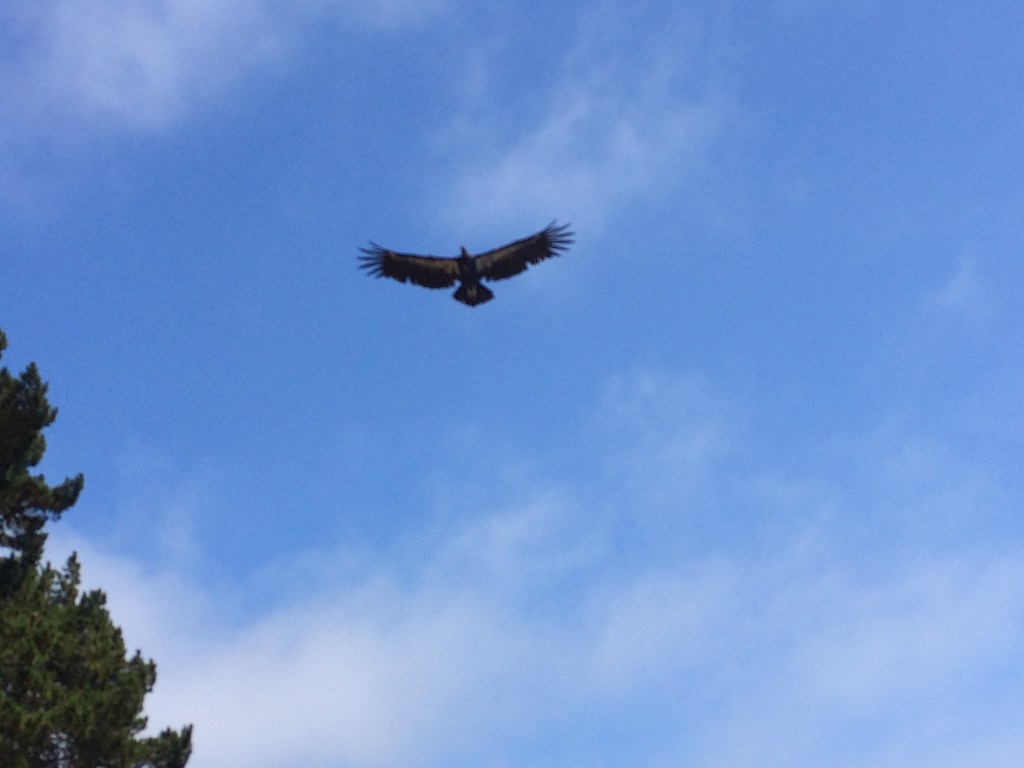
Once airborne, they soared out over the ocean, glaring back at us as we stood assessing the damage. As they flew, I pointed towards one of them and said to Susan, “That one’s different. It’s quite a bit bigger, has white markings on the underside of its wings, and it flies a little differently.” As we watched, it came in closer to us. I said, “I think that’s a California condor!” We had been trying to spot one all day, and here we were now getting a close up look after it had ransacked our porch.
As we started to put things back in order, the condor left his mates, who had flown off to find something dead on the beach, and landed on a low branch of a fir tree at the edge of the yard. We moved slowly across the lawn to get a better look. The huge bird seemed totally unperturbed by our approach. We confirmed that it was a condor, but also discovered that it had a huge wing-patch marker emblazoned with the number “26.” Susan said, “Well, at least we know its name.”
We walked back to the patio, puzzled by why this huge flock of carrion-eating scavengers had chosen our patio as their restaurant. Susan started putting the cushions back on the chairs, and I went over to put the screen back in the window. Just as I got it back in, she shouted out, “Come over here. You’re not going to believe this.”
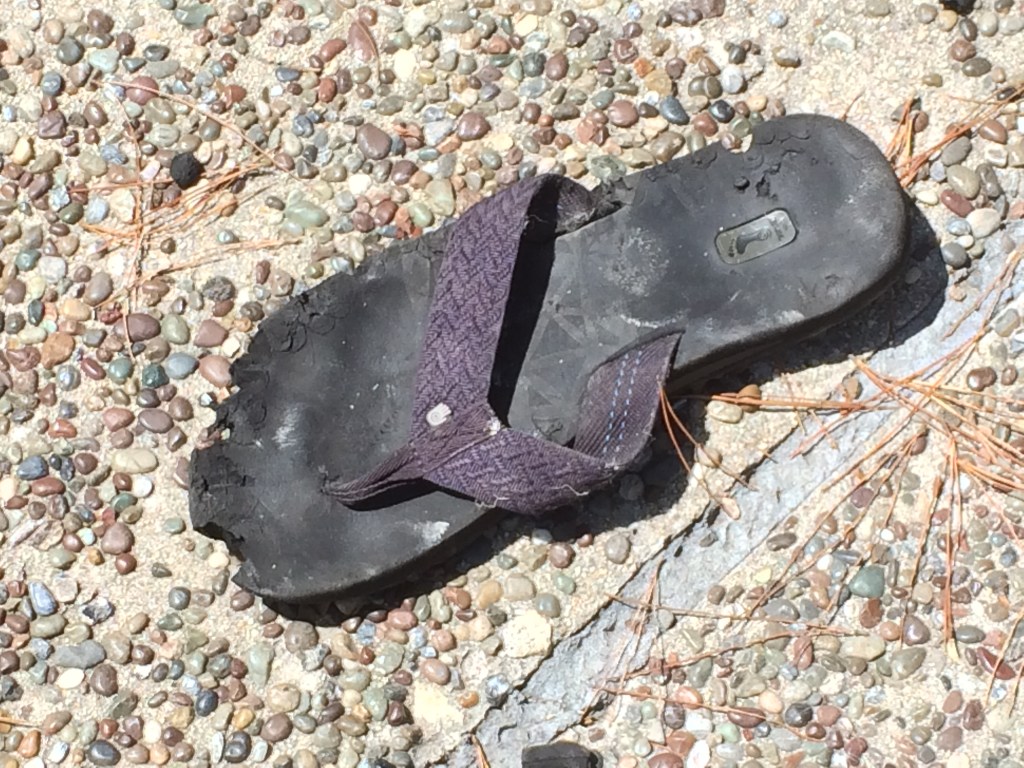
When I got to where she was standing, she simply pointed to the ground without comment. There, beside the chaise lounge, were her flip flops that she had left out the day before. Or should I say, what were left of her flip flops. They had been shredded by our feathered guests (see picture). I said to Susan, “I guess once they realized it was not a decomposing raccoon, they threw a hissy fit.”
“You mean to tell me my flip flops smell like a dead, rotting animal?”
“Your words, not mine.”
To explain why the scavengers attacked, I looked up how vultures “hunt” on the internet. I found this post from “Buckabuckaw” on Reddit. I’m using it because I couldn’t have said it any better.
“Turkey vultures have an extremely sensitive olfactory system, and they can detect a single molecule of cadaverine or other compounds given off by dead animals. Then they cast back and forth the way a tracking hound does, until they detect a gradient and can follow the gradient “upstream” to find the source.”
Good word – cadaverine.
We double-sealed the flip flop remains in a plastic bag and placed them in a secure trash container. We had considered just throwing them over the cliff, but we didn’t want to mislead and disappoint any other scavengers.
I went inside and looked up condor rescue operations on my computer. The California Condor Recovery Program run by the U.S. Fish and Wildlife Service seemed to be my best bet, so I gave them a call.
“Hello. This is the California Condor Recovery Program.”
“I’d like to report a tagged condor that has been lurking around our rental cottage. It has a number “26” tag on its wing. Is it one of yours?”
“Probably. Just a sec…” He went off-line for a minute, and then came back on. “Yep. He’s one of ours.”
“Well, I hate to be the bearer of bad news, but he’s hanging out with a rather nasty crowd.”
“What do you mean?”
“He and about twenty of his rowdy turkey vulture friends assaulted my wife’s flip flops.”
After a long pause, the agent asked, “Did you say flip flops?”
“Yes, sir.”
“Was she wearing them at the time?” Fish and Wildlife agents apparently have a good sense of humor.”
“No, she’s fine, but those flips will never flop again. Just thought I’d let you know he’s hanging out with a bad crowd.”
He sighed. “These sorts of things happen. You take them in as an egg, watch over them as they struggle out of the shell, give them all the best dead things in life, and then send them out into the world. After that, you have no control over the bad decisions they’re going to make.”
I assumed that had had raised teenagers at some point in his life, gave him our address, and thanked him for his time.
The next morning, as we were packing our rental car to head off to the airport, I felt like someone was watching me. I looked up, and there, perched on the front peak of our roof, was Number 26, apparently expecting Susan to leave a shoe or sneaker for him to savage after we departed. I said, “Sorry, 26. That’s all we got.”
As a bit of a postscript, as I was writing this little story, I looked up the California Condor Recovery Program on my computer again to make sure my information was accurate. Yes, I actually look things up. I know it doesn’t seem like it, but I do. As I scrolled down through the pictures on their website, I came upon a photo taken in 2023 of a very good-looking condor posing on a tree stump. Yep. Number 26! A poster boy for the Fish and Wildlife Service.
The Camping Trip – Final Installment Posted 9/19/2024
San Francisco beckoned. As the center of the “underground,” psychedelic scene, the music that emanated from the city was to us like the Siren’s song was to Ulysses, even if many of the bands were back on the East Coast playing in some farmer’s field in New York. We didn’t need to be tied to a mast, either.
The Madison Hotel was our destination. Or was it the “Hotel Madison?” “Hotel Madison” sounds a bit more swanky, but this dive’s swank had left town a long time ago. Swank, gone. Stank? Still present. So, Madison Hotel it is. I’m trying to remember if the room was $10 for all four of us. I hope that was all we paid because $10 a piece would have been a rip-off. Hotel? No, think flophouse.
The room was beautifully decorated with an old, beat-up, wooden chest of drawers replete with stylish brown paint peeling from the top and sides. There was plenty of room to spread out since it had six beds. Well, it had six metal-framed cots with folding legs spanned by bands of metal attached (more or less) to the edges of the frames by springs that had mostly sprung. You could tell that many people had enjoyed (?) a stay there by the depressions in the thin mattresses, covered in the traditional, worn and faded cotton, blue-striped ticking that had become so popular in prison cells. Folded linens were at the foot of each bed, but I think we all decided to haul up our sleeping bags. It was to be our only night not spent in tents, but the sleeping bags seemed to be the safer option.
It did have running water. You could tell it was running because that’s what the toilet did intermittently all night. Yes, it had a toilet, and a sink. I was curious how the hotel managed to get both amenities with matching brown stains around the drain area that faded up to a lovely cream color around the upper edges of the bowls. Nice touch.
And, that’s all I remember about San Francisco, on that visit, anyway. I carried a business card from the Madison Hotel around in my wallet for many years, just to remind me how low the bar can be set when renting a room. I just tried looking for the Madison on a couple of search engines on the internet. No dice. I’m assuming it collapsed (mercifully) years ago in an earthquake.
We picked up the Pacific Coast Highway (SR1) west of San Francisco because we didn’t know the way to San Jose. Also, it wasn’t really on the way to our destination: Riverside Campground, Big Sur. If you’ve never had the opportunity to drive this stretch of road, make some time to do it. It is truly spectacular. However, as of this moment, I believe one section of it is closed from a combined landslide and road collapse, a rather common occurrence due to the way the highway is etched into the cliffside.
The Riverside Campground lived up to its name; the Big Sur River runs right through it. We got a campsite where we could hear the soothing sounds of the water weaving its way through the deep forest, much more to my liking than the city noise of San Francisco and the gurgling of the water running through the pipes of our brown toilet in the Madison Hotel. We set up our tents, checked out a few of the trails along the river, and explored the camp store to see what they might have to supplement whatever was left in our coolers. There were a few campsites around us, but they remained unoccupied through our dinner. Serene.
As darkness settled in, we could see a few campfires light up on the other side of the campground, and we could hear people singing along to someone strumming a guitar. Since we had our own “band,” we decided to see if we could sit in for a few songs.
Now, it wasn’t really a “band.” It was me playing my 12-string Gibson accompanied by a rhythm section comprised of John, Loring, and Bruce thumping on Tupperware “drums.” By pooling the resources of four families, we had containers ranging in size from a percussion piece you might find in a set of timpani to a small bongo. A formidable array. And everyone knows how great a drum circle sounds backing up acoustic music.
After playing along with our new-found friends on a few songs, we were delighted (and surprised) that we had not been kicked out, banished back to the other side of the campground. As we continued to play, a figure approached from out of the darkness and stood at the edge of the light cast by the flames. When we finished playing our song, we expected him to tell us to shut up (but using stronger language). Instead, he said, almost in a conspiratorial whisper, “Do you guys know Simon and Garfunkel are camped on the other side of the campground?”
I said, “No, but if you hum a few bars, we’ll fake it.”
He didn’t laugh. He simply stared at us for a few seconds, pointed in the direction of our tents, and wandered off into the darkness
Since our camp site was over there, and we hadn’t seen anyone move in, we assumed he was full of it, or perhaps enjoying a bit too much of “nature’s own.” Ten minutes later, another apparition materialized from the forest and delivered the same message. What’s that expression about “fool me once?”
So, we packed up the “instruments” and headed back towards our tents. I wasn’t sure, but I thought I heard applause coming from the campfire we had just left.
And there, just one campsite away from ours, sat Simon and Garfunkel, hunkered down around their own campfire along with just a few other campers. Paul Simon was playing his guitar and singing oldies, a lot of Everly Brothers-type tunes that allowed everyone to contribute some kind of harmony part to the mix. Art Garfunkel sat on a rock in total silence and stared into the fire, obviously under the influence of some other-worldly substance. He didn’t move a muscle and said nothing the whole time we were there, which was quite a long time. In the future, anytime I encountered anyone in such a catatonic stupor, I would say they were “Garfunkeled.”
Simon’s musical repertoire was extensive. Amazingly, he only played one of his own compositions: “The Boxer.” Quite timidly, I joined in on a few that I knew well, but wisely, the rhythm section remained silent. Finally, after graciously sharing his talents with all of us late into the night, he and his partner headed for their tents. They disappeared the following morning, long before we crawled out of our tents.
We may have missed Woodstock, but we got to sit by a campfire in Big Sur and sing along with Paul Simon.
Many months later, I went to a Simon and Garfunkel concert that was held at the old convention center on the Penn campus. During a pause between songs, from my seat up in the balcony, I yelled out, “Riverside Campground!” They both turned towards me, smiled, and gave me a big wave.
And that was my one and only encounter with famous people. Except towards the end of our trip when we ended up at a private dinner with Elvis at Graceland. I decided to leave that out of the story since I figured you wouldn’t be all that interested.
The Camping Trip – Part 3 Posted 9/12/2024
We crossed the border into Idaho where I90 crosses the state at its thin “neck.” Idaho looks a bit odd when compared with all the other huge, rectangular states out west. In some ways, it appears to be a giant version of Delaware. Idaho is 33x bigger yet only has double the population of The First State (that’s Delaware).
That’s because no one really lives there. As I explained in “The Camping Trip – Part 2,” the two million people who claim they live there are really just workers from other states.
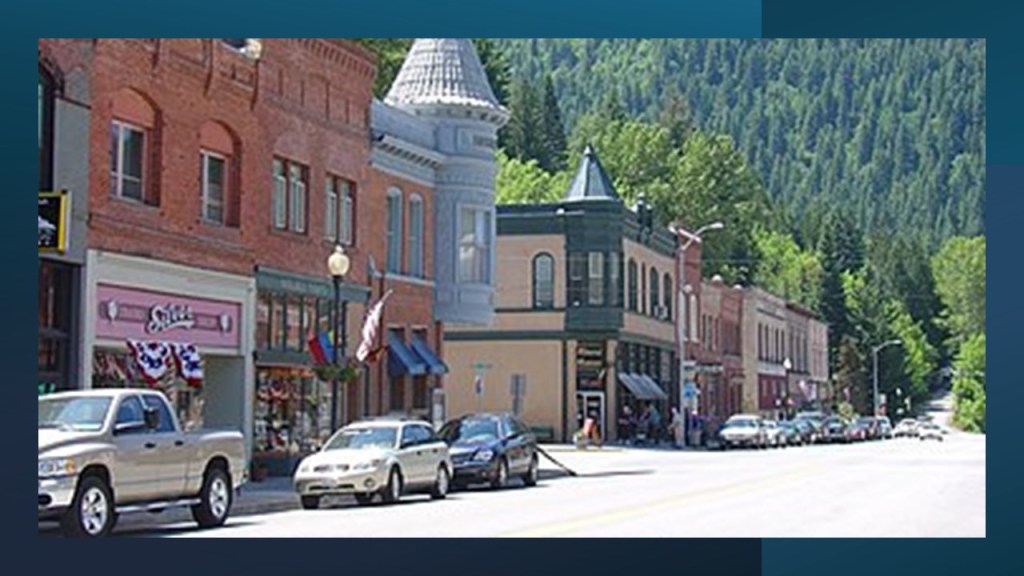
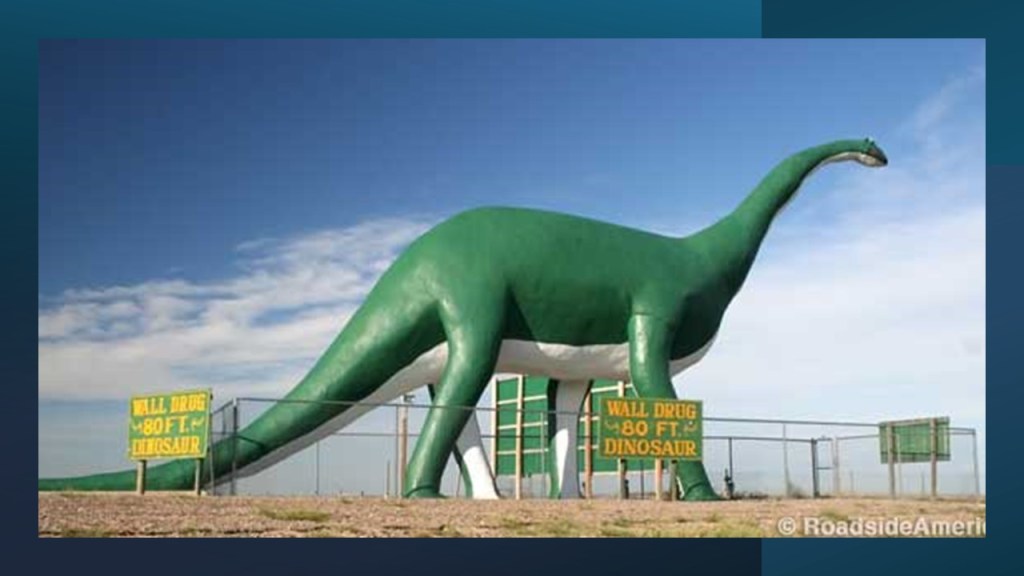
The first town we encountered was Wallace. As we drove down the main street (the only street) we noticed very few people out on the sidewalk. To get an idea about what Wallace looked like, think about the storefronts the townsfolk in “Blazing Saddles” erected to fool the bad guys. As it turns out, the buildings, the cars parked on the street, and the stiff, immobile people were only painted, plywood cutouts. At least, that’s how it appeared to us since we didn’t get out to take a closer look. Look at the picture above. Note the town is almost entirely devoid of people, except the few in front of the Mineral Museum.
That’s right: The Mineral Museum. Not exactly Wall Drug.
We tentatively rolled down our car windows when we stopped at a stop sign in the center of town. An eerie silence pervaded the deserted streets. However, off in the distance, we could hear the muted sounds of chainsaws in the deep forests and the heavy farm machinery unearthing Russett potatoes. Having proven our theory that no one actually lives in Idaho, we rolled up our windows and fled the town before the “Idaho Deep State” conscripted us into service.
As the city (I use the term loosely) limits faded away in the rear view mirror, John asked me, “Did you hear something weird back there?”
“What? The farm machinery? The chainsaws?”
“Yeah, the chainsaws. Whenever the buzzing noise paused, I thought I could hear someone singing, ‘I’m a lumberjack, and I’m okay.’”
I shook my head. “Can’t be. That Python episode won’t air for another several months.”
John thought about that. “Yeah, I guess you’re right.”
The topic of the song never came up again, and although we saw several signs for other towns as we made our way west through Idaho, we didn’t stop again until we hit the Washington State border.
All of us were excited to be getting to Washington. We planned to spend up to a week there because the Wenatchee Forest had so much to offer in terms of hiking, fishing, and camping opportunities. Personally, I couldn’t wait to be immersed in that wonderful “pine” scent that I like so much in the Adirondacks. But in Wenatchee, the trees would be hemlocks, yews, cedars, huge Douglas firs, and The Larch.
Whoops. Another Python Lumberjack reference.
The Douglas fir is named after David Douglas, a Scottish botanist who was famous for dying in Hawaii after forming the Tex-Mex group, the Sir Douglas Quintet.
That last part isn’t true, but he did die in Hawaii after being only the second European to reach the summit of Mauna Loa. But that’s not why or how he died. Douglas fell into a pit trap while climbing Mauna Kea and was mauled to death by a bull. He should have been watching where he was going. Anyway, enough about Douglas.
In Washington, we were also looking forward to meeting up with our good friend from high school, Kinglsey, who was working as an honest-to-God forest ranger out there. His father had some connections in the park system since he was a botanist, like David Douglas, but unlike Douglas, he never fell in a pit trap. Well, maybe Kingsley was just an assistant ranger or cleaned the campground bathrooms, not totally sure, but he did know his way around the place and had a good source for obtaining Boones Farm wine.
Even though we stayed a week, I don’t remember much about it except that we had a good time and got chased by a bear while we were trout fishing. When I saw the bear on the trail above the spot where we were fishing, I threw our stringer of beautiful trout out into the middle of the stream and took off, figuring the bear would go for the fish instead of me. Turns out the bear didn’t even know we existed and continued on down the trail, which meant that I had to wade out into the middle of the stream to retrieve our fish from the icy, cold mountain waters. It took a while to find the stringer; we were lucky it got hung up on some rocks and dead wood. We were also lucky the bear couldn’t have cared less about us.
And, throughout all this, none of us fell into a pit trap, with or without a bull in it.
After leaving Washington, Kinglsey, and the bear behind, we made our way to Roseburg, Oregon, where we lost Rob. Well, we didn’t really lose him. The Rambler broke down (remember, it was on its last wheels) and after a lengthy, and probably expensive, collect call back to his parents, they decided that he should just sell the car to a junk dealer out there and fly home.
We said our goodbyes, dropped Rob off at the airport, and since four of us now had to cram into the Impala with all our camping gear, we sent him home with one of our coolers filled with dirty laundry. I really would not want to have been the person to open that up upon arrival back in Ithan, PA.
Our campground in Roseburg left a lot to be desired. It was mainly a mix of motorhomes, camping trailers, and semi-permanent double-wides with a few tents scattered amongst them. Some of the double-wides actually had either pink flamingoes or garden gnomes, or both. We found a spot away from all the action, pitched the tents, and since there were no fish to catch in our urban campground, heated up some cans of Chef Boyardee ravioli and washed them down with some Boones Farm.
To say I missed the Douglas firs and trout would be an understatement.
While Rob was in the air flying home, we crawled into our sleeping bags, and just as we began to doze off, the ground began to tremble. I thought it was just some indigestion from our dinner; a little Chef Boy-Oh-Boy acting up as it became pickled in digestive juices and apple wine. The trembling grew worse quickly, and it was accompanied by a blast from an incredibly loud horn. I stuck my head out of the tent flap and was blinded by the headlight of a huge train engine bearing right down on top of us.
“Holy shit!” I screamed. “Everyone wake up. Get out of the tents!!”
Now, logically, we should have known that a train couldn’t run over us because we weren’t stupid enough to have pitched our tents right on the tracks, even though we WERE stupid enough to eat Chef Boyardee ravioli right out of the can. In fact, we hadn’t paid any attention to the track location when we set up camp. However, we weren’t thinking too clearly (understatement) as were dozing off. What’s that song? “Dazed and Confused?” Anyway, at the last minute, the train veered away, saving us from an untimely death, like the way David Douglas died falling into a pit trap with a bull.
In the morning, we could clearly see that we had pitched our tents on a bend in the rail bed which created our illusory certain deaths. Time to get the hell out of Roseburg and finally get to meet up with famous people.
Yeah, I know that in “The Camping Trip – Part 2” I said we would meet up with them in this episode. It wasn’t a lie; I simply had too many things to say. Next time – I promise!
The Camping Trip – Part 2 Posted 9/7 2024
When last we heard from our intrepid campers, that’s John and me, we had left the Atlantic City Pop Festival to meet up with our friends, Loring, Bruce, and Rob, to begin our journey in earnest. Actually, we began our journey in a Chevy Impala and a Rambler station wagon. As I mentioned in the last episode, the Rambler was on its last legs. For a car, shouldn’t that be “on its last wheels?” Just something to think about.
Before going to the Pop Festival (it was rock ‘n’ roll music and had nothing to do with soda – I added that in case anyone from Pittsburgh was reading this), I had spent hours digging into a huge Rand McNally Road Atlas. It was a giant book of maps, one from each state, that also included magnified inserts that showed the spidery patterns of roads surrounding the larger cities. Thinking back on it now, I’m not sure states such as Rhode Island or Delaware had a page all to themselves.
You remember what maps are, right? I’m speaking now to readers of “a certain age.” They’re those things that lived in your glove compartment under your gloves. Just kidding. NO ONE kept gloves in their glove compartment. The other place the maps hid was the side pockets on the driver or passenger side doors. Mine were stuffed to over-flowing. They were readily available in just about any gas station, and they were easy for the passenger in the car to unfold and use while you kept driving, that is until the unfolded map got in your way as it flapped around like a giant bird inside the car because the windows were open, causing you to die in a fiery crash. Some cars had air conditioning in the 1960s, but none of them could be found in my family’s driveway. This was before global warming, so it didn’t really bother me.
The real fun came when it was time to fold the map up to put back in the glove compartment. It had to be folded so that the title page, the one that spelled out the name of the state, had to be facing outward on the front. Trying to accomplish this was where old Rubric got his idea for the cube.
In the atlas, the state maps were arranged alphabetically, so if you wanted to drive from Pennsylvania into Ohio, which we did, you had to flip to the page number listed on the left-hand side of the Pennsylvania map to continue on into Ohio, making it a somewhat cumbersome process. Minnesota into South Dakota, another state-to-state transition we needed to make, involved even more page flipping. The idea was to match my list of camping destinations to places on the map in such a way that it would only take one day, or less, to get from one campground to the next. We needed to visit a lot of campgrounds, but eventually I had a track plotted out. The overall process was tedious, but I actually like using maps, so much so that I became a navigator in the Navy. BTW – Rand McNally still produces atlases on an annual basis, just in case you have a desire to go retro and tell the little automated GPS voice to shut-up.
The first Wall Drug sign appeared before we arrived at Indiana Dunes on the eastern shore of Lake Michigan. I have been told that this was not an official Wall Drug sign, and that the official sign most distant from the actual tourist trap is actually in Wisconsin. As it turns out, there are Wall Drug signs in India and Argentina erected and maintained by people who apparently have nothing better to do with their time, such as lobbying for world peace. I’m sure many of you have been to South of the Border since the eastern corridor between New York and Florida is more heavily traveled. For those of you that have been to South of the Border, Wall Drug is MUCH worse. Or much BETTER, depending on how you regard these types of places. As a kid, I liked South of the Border because you could buy fireworks there. That’s about all it had going for it. Wall Drug, however, has a 80-foot model of a Brontosaurus, in addition to lots of other trashy things to separate a weary tourist from his or her money. More on the Brontosaurus later.
As I said, “weary tourist” because there is NOTHING ELSE to do in South Dakota except drive to the few isolated and far-flung scenic areas, such as the heads of three important presidents and Teddy Roosevelt carved into a sacred mountain that we stole from the Native Americans, who had already signed a contract to put in an Arby’s.
Not true.
Fun fact about Teddy – there were “teddy bears” BEFORE Teddy Roosevelt saw koalas in Australia, but they were modeled on “real” bears, not ones that put “shrimp on the barbie.” They don’t really put “shrimp on the barbie;” they eat eucalyptus leaves that are so low in nutrients that the cute, little, fuzzy bears, er, koalas, have to sleep 18 to 20 hours a day due to a low metabolic rate. Think marsupial sloth. Roosevelt simply said they looked like “his teddy bears.” He cannot be held responsible for us calling a cute, eucalyptus-eating marsupial a “bear,” something I have done by reflex up until I was about 50.
Now it’s time to get down to the heart of the matter; let’s face it, South Dakota shouldn’t even be a state. Neither should North Dakota. It should just be “Dakota.” There are a lot of state and federal government officials associated with these two states drawing in hefty salaries and pensions. Make one state! Think of the money that would be saved. If the population numbers in both states are added together, they would have just a few more people than Hawaii, and the Hawaiians are crammed into a few tiny (but beautiful) islands while the Dakotans (Dakotians? Dakotites?) have tons of room to roam, especially after killing off all those bison.
But South Dakota has a Brontosaurus residing at Wall Drug. Hawaii doesn’t have a Brontosaurus; that’s because they don’t NEED a 60-foot, fiberglass model of an extinct dinosaur to draw people to their incredible state. South Dakota does. Sad. “Dakota.” Think about it. Talk it up at parties. Ignore the odd looks.
Here’s another talking point (if the people you were talking to haven’t walked away yet, shaking their heads). Puerto Rico has more people than both North and South Dakota combined. We could make it a state and still keep the same number of stars on the flag.
We did stop at Wall Drug because I needed film to take a picture of Mt. Rushmore, the heads of the three important presidents and Teddy Roosevelt carved into a sacred mountainside. After that, we camped in Wyoming and the next day, raced into Montana. And I do mean “raced.” At the time, Montana didn’t have speed limits on their big highways, so I got to drive the Impala at 110 mph, leaving the Rambler in my dust, of which there was a copious amount. There’s so much dust out there I’m surprised it never comes up in “America the Beautiful.”
“O beautiful for spacious skies, For amber waves of grain,
For purple mountain majesties, Above the dusty plain!”
We arrived at our campground in one of Montana’s Wilderness Areas (they have three) and slept with hatchets under our pillows in case we were attacked by wolverines in the middle of the night. We had heard from reliable locals that this was a distinct possibility. They said all their houses had steel doors and metal shutters to keep the Tasmanian Devil-like beasts from killing them in their sleep.
That’s what they told us, anyway. We were pretty gullible. We didn’t know much about the ferocious beasts since Wolverine hadn’t entered the Marvel Universe by that time.
We were excited the next day because, (a) we were still alive, and (b) we were about to fulfill the real purpose, the goal, of our trip. We weren’t just young college kids on a lark. Oh, no! We were there to prove that no one actually lives in Idaho! That’s right. Have you ever met anyone from Idaho?
I didn’t think so. If you met someone who said they were from Idaho, they were lying to cover up the fact that they are part of the “deep state” conspiracy that keeps the politicians from Idaho in business, similar to the situation we have in “Dakota.” The politicians control all the spuds and logs. Of course, back when we were there, no one talked about the “deep state” like they do today. It was over-shadowed by the evil Military-Industrial Complex.
Idaho exists to grow potatoes and harvest trees for the lumber industry. That’s all they have going for them. This is done by people in the surrounding states who scurry home in the cover of darkness after a hard day’s work in Idaho. It was our plan to slip across the border to witness this for ourselves. We didn’t need to really “slip” across the border since we would be doing it in broad daylight on Interstate 90. No one would be paying any attention to us since they were all engrossed in pulling up taters or cutting down trees.
So, next stop: Wallace, Idaho, in “The Camping Trip – Part 3,” the part of the story where we also get to hang with famous people in Big Sur, California.
The Camping Trip – Part 1 Posted 8/31/2024
The Atlantic City Pop Festival in 1969 was just the prelude to the camping trip. My friend John and I went to the three-day event to see and hear one of the greatest line-ups of bands ever assembled. This occurred two weeks before Woodstock and there was a great deal of overlap in terms of the performances.
That’s where the similarity stops.
The Pop Festival was held in the now-extinct Atlantic City Race Course. A lot of the racing horses are glad it’s extinct. Now, they just have to jump off diving boards into the ocean at a rickety pier at the beach.
Thankfully, I don’t think they do that anymore, either.
As compared with Woodstock, it was an intimate gathering of just (just) 100,000 people who were willing to cough up $15 for the whole three days of music. You were on your own for the drinking and grass and whatever. Entrance security was tight since it was in an enclosed venue, so no one got up on stage, as they did at Woodstock, and announced, “Hey, everybody! It’s a free concert!” As far as I was concerned, for $5 a day, it was a free concert.
And, it didn’t rain. There was no mud. Where’s the fun in that?
John and had come equipped with some bottles of high-quality wine since we were such sophisticated connoisseurs. For convenience sake, and for convenience sake only, we made sure the bottles of Boone’s Farm Apple Wine and Strawberry Hill were equipped with screw-off caps so we didn’t need to bother with carrying around a cumbersome corkscrew.
By the way, some of you English-types are probably muttering to yourselves as you eat your buttered scones, “‘Convenience’ is possessive and should have an apostrophe.’” NOT SO FAST. Because no one ever says, “For conveniencessss sake.” I added the extra “esses” to make a point; we, the blog-writing illiterate, don’t have to use it.
Back to the wine. Anyway, we apparently strolled right in with it in our backpacks. I don’t remember exactly if that’s how it went since the details have become blurred over time. Or maybe they were blurred at the time. We were under 21-years of age, but I acquired this wine when I was up at Blue Mountain Lake in New York where the drinking age was 18. It was very expensive. One of the local liquor store/bars sold it for $12 for a “baker’s dozen.” (Please notice I used the apostrophe there.) That’s right, just $1 per bottle, plus a freebie in case you didn’t get sick enough drinking the first twelve.
We looked old enough to have booze in our possession at the concert, but there were three guys in front of us that looked like they belonged in the Mickey Mouse Club, and they were swilling some Carlo Rossi Mountain Red straight out of the gallon jug. We didn’t want to stay close to them for very long because we were certain a technicolor yawn was going to erupt in the near future, however, watching them maneuver the heavy, awkward bottle provided some entertainment between acts. That is, until one dude (I know they weren’t called “dudes” back then) tried to swig it straight down by flinging his head back and then swinging the bottle up over his head while holding the little glass loop at the neck between his fingers and thumb.
Did I mention that they looked young? They also didn’t look very strong, and our beliefs were confirmed when the bottle went over his head and soared into the air behind him as his thin, little digits lost their grip. It didn’t soar for very long. Carlo Rossi makes a heavy wine, and it came crashing down on the concrete, painting several concert goers in deep red. It was their fault; they were paying attention to what was happening on the stage instead of the imminent danger just behind them. You’ve heard of people crying over spilled milk. This was much worse. The children had lost their only source of booze, and the wet spectators were now targets for yellow jackets.
An argument ensued. We moved.
Jefferson Airplane came on and made everyone forget about the incident. Well, we forgot about it because we moved. In fact, I hadn’t thought about until just now when I was writing about our camping trip.
“Camping trip?” you ask. Don’t worry, I’ll get around to it. Maybe in “Part 2.”
As I was saying, Jefferson Airplane came on, performing some well-known tunes but also introducing a few new ones from their about-to-be released “Volunteers” album. They were loud, but apparently not loud enough for some members of the audience. When they launched into the title song of the new record, someone began to climb the scaffolding that held the huge speakers that generated enough volume that talking during a show was impossible. Now, the likely explanation for someone going up there was that there were equipment difficulties. However, none of the stagehands were dressed in Levi cut-off shorts and tie-dyed tee shirts, so we assumed that it was someone either hard of hearing or on something more potent than Carlo Rossi Red. I was guessing the latter.
When he reached a speaker that looked comfortable, he curled up on the scaffolding platform and rested his head INSIDE THE HORN. I used “caps” and an extra-large font there because I assume this is how people have to talk to him now that he’s in his seventies. That is, if he made it that far.
Anyway, the rest of the concert was uneventful, unless you enjoy hearing and seeing awesomely great performances from some of the most classic rock bands ever assembled. However, at the time, we didn’t realize they were “classic.” I wish someone had billed the performers that way; we probably would have appreciated it much more.
The concert ended, and it was now time to head back home, collect our three friends, Loring, Bruce, and Rob, the guys who were going with us, and hit the road. This was an especially important stop in the trip since we were taking cars that belonged to Bruce’s parents and Rob’s parents, a relatively late-model Chevy Impala and Rambler station wagon, respectively. If the Rambler had had the ability to think about circumnavigating the country, and knew there would be steep mountains out west, it probably would have sounded like the Little Engine That Could. “I think I can, I think I can.”
We’ll see in Part 2. Always end with a cliff-hanger.
Dick Mack’s Posted 8/21/2024
What can I say about Dick Mack’s? Stating that it’s my favorite pub of all time doesn’t say much since it’s only my opinion based on my personal experiences from bar-hopping all over our country and the four corners of the world.
That last part is just an expression, an odd expression, at that. I’m not a member of the Flat Earth Society. Anyway, back to Dick Mack’s.
To begin with, it’s not your everyday, ordinary Irish pub. It’s half pub and half cobbler shop. Sure. Why not? As you enter, the cobbler section is to your left, and the bar, complete with a snug to sequester the women and children, is on the right. The pub is nestled in the town of Dingle on the west coast of Ireland, situated on a rather non-descript street across from a Catholic church. It’s perfectly situated to capture the men as they leave mass on Sunday.
Did I mention that Dingle is my favorite town in Ireland? Maybe that has something to do with Dick Mack’s being my favorite pub.
It’s now run by Dick Mack’s son, Oliver, who spends most of his time on the left side doing the cobbing. Cobbling? Cobblering? Anyway, he works with leather. The inhabitants on the right side, where the Guinness and Smithwick’s await anxiously in their taps, are the reason the place is so special. One of these regulars is Maz, a slightly plump woman with a huge, beautiful voice. She owns a record shop just down the block from Dick Mack’s. Maz has a big laugh and is quite possibly the most spontaneous person I know. One winter night as I was making dinner back home in Pennsylvania, the phone rang.
“Jack! It’s Maz! How are ya?”
It took me a while to focus in on who this person was; it had been almost a year since I had last seen her in Dingle. “Maz? From Dingle?”
“How many Maz’s do ya know?”
She had a point. There is only one. “Why are you calling from Ireland? Is everyone okay there? Is Dennis alright?” I’ll get to Dennis in a bit.
“Sure. Sure. Aren’t they all grand. No, I’m in Boston with friends. We’ve got a bus and we’re leaving for Mardi Gras tomorrow. Can we pick you up on the way?”
Now, you’d be crazy to think that I didn’t, if even just for a split second, think about saying “yes.” A bus, loaded with some crazies from Ireland and Boston heading for Mardi Gras. Pick me up? Here’s my address.
But, no, being a responsible person who hates to have a good time, I said, “I can’t possibly, Maz. I have a job that I can’t just walk away from.” I was a high school teacher. Mentally, I was totally prepared to walk away from that job. Financially? That’s another story altogether.
“Ah, that’s too bad. It’s going to be fun. Wish ya could join us. I’ll have a drink for ya when I’m there. Maybe two. See ya next time you’re in Dingle. Bye.” *click*
I wish I could tell you that the bus broke down, they never got there, and they had a horrible time having to spend a week in Hoboken as the bus got repaired. I wish I could, but I can’t. As Maz would say, “It was grand, wasn’t it? It was all grand.”
Dennis was one of the people who always seemed to be at the bar in Dick Mack’s. Dennis lived with his border collie in a small stone cottage surrounded by sheep just outside of town. Since day-to-day, the sheep could take care of themselves with some help from the dog, Dennis would either be at Dick Mack’s or he would be on a neighbor’s property supplementing his sheep income by poaching trout.
The story goes that one day, Dennis himself got hooked and received a citation for his illegal poaching activity. He was to pay the fine to the head constable in the town hall later in the week, but when he went in, he told the man he didn’t have enough cash to cover the fee. “I’m just a poor sheep farmer,” he explained.
The constable knew Dennis quite well, and taking pity on him said, “Well, is there something of equal value that I could receive for your payment?” The next day, Dennis came back and paid his fine with a stringer of large trout.
Dennis was always dressed in leather work shoes, trousers made of some heavy brown material that looked like canvas, and a cotton, collarless “grand daddy” shirt. The shirt was ivory in color with pale blue pinstripes. I think it started out white. I was hoping that he had multiple copies of each of these garments, but I seriously doubted it.
Dennis was an elderly gent who fancied himself to be quite the ladies’ man. If a lovely young woman entered the bar, he would glance their way, excuse himself from our conversation, then make his way over to deliver his sure-fire, patented, pick-up line.
“Allo, chicken. How’s yer mother?”
Really. He thought this would work. It never did, as far as I could see. Usually, the target of his affections would look startled, then smile and giggle slightly as she moved discreetly to another section of the bar. That he failed in these endeavors never seemed to bother Dennis. He would stand quietly holding his pint, watch them as they walked away, and then return to our conversation as if nothing had happened.
Late one afternoon, my friend Brian and I were at a table near the snug talking with Dennis and having a couple of pints. At the far end of the bar from us, three men were conversing in a mix of English and French. Dennis commented that they were getting more tourists from France, and we thought no more about them. That is, until the biggest Irishman we had ever laid eyes on, the size of an NFL lineman, came in through the front door followed by his two trolls. The giant’s head was topped with a blaze of close-cropped, carrot-colored hair. He was dressed all in black leather, as were his henchmen. We were curious about this since we hadn’t heard any motorcycles pull up outside.
Sasquatch already appeared to be half in the bag, swaying a bit unsteadily as he surveyed the room, with a scowl on his face. He was looking for trouble and found it when he spotted the Frenchmen sipping on their pints. As he made his way up to the bar, he motioned for his two goons to follow. The three of us cautiously watched this as it played out.
Each of the three leather-clad men got their pints and listened to the Frenchmen converse. After a few minutes, Carrottop handed his pint to one of his thugs and, putting his hand over his heart, began to sing loudly to the tune of “La Marseillaise,” the French national anthem.
“Oh, a Frenchman went to the lavatree, to take a piss and to take a shit.
He took his coat and his trousers off, so he could wallow around in it.”
Sensing trouble Brian and I leapt from our chairs and dove behind the cobblers bench, searching for hammers or any other implements of destruction that we could wield in case the impending altercation spread. Dennis, whether unaware of what was happening or too drunk to move, possibly both, maintained his ringside seat.
The Frenchmen turned slowly around on their stools and stood to face the Irishman. They looked at each other, summing up the opposition. No one could have anticipated what happened next. One of the Frenchmen extended his hand to the big man in a friendly greeting and said, “We are from Brittany. We Bretons do not hold the rest of France in high regard. In fact, we even speak a Celtic language similar to what we’ve been hearing here on the west coast of your beautiful country.”
Stunned, the giant Irishman paused a moment, then took the Breton’s hand, shook it, and said, “Pleased to meetcha. Can I buy ya a pint?”
Feeling a bit foolish, Brian and I crawled out from behind the cobbler’s bench and took our seats. Dennis looked at us and said, “Yer man here was itchin’ for a fight, but the Frenchies diffused it.” Shaking his head, he glanced over at them. “Never know what yer gonna see in here.” He turned back to us. “Why don’t you lads sing us a song to keep the friendliness flowing, and ya kin buy me another pint while yer getting’ yourselves ready.”
So, we did.
Here’s the song I wrote about “Dick Mack’s.” It starts with the chorus. Key of “G” with a nice, crisp rhythm:
“Dick Mack’s, a hammer and a tack, a Guinness or a Smithwick’s,
With your neighbor there’s good craic (crack).
At Dick Mack’s where a soul (sole) is treated right,
And you never get the boot until it’s late into the night.”
“There’s a place in Dingle that’s mightily confused,
A cobbler’s or a barroom, it’s either one you choose.
On the left you’ll find a hat, perhaps some women’s shoes,
But on the right you’ll down a pint and catch the local news, at…” (repeat chorus)
“So go on in and have yourself a belt,
Or buy one made of leather there’s a lot of them about.
Then drink up and put it ’round your waist,
There’s something here for everyone, no matter what your taste, at…” (repeat chorus)
“Maz has a shop just down the block,
She sells her tapes and records, but doesn’t mind the clock.
Sign says she opens up at ten,
But she sang and drank a lot last night, she’ll come in who knows when, at…” (repeat chorus)
“PJ sings at Murphy’s by the dock,
Some Irish or some country, but never any rock,
Jay paints them all with tender, loving care,
If he isn’t at the Benner, you’ll find him over there, at…” (repeat chorus).
“Time! Time! It’s getting awfully late.
Your dog is barking, Dennis, she’s waiting at your gate.
We stumble out into the darkness and the rain,
But come around 11 and we can start it all again, at…” (finish with chorus)
What’s Hot in Ireland? Posted 8/17/2024
Several years ago, we were on vacation in Ireland. By “we,” I mean my best friend and singing partner, Brian, his wife, Nancy, and my wife, Susan. Brian and I had formed a Celtic folk band after discovering that we could get free drinks on St. Patrick’s Day by going from bar to bar in West Chester, PA. We’d play three or four songs, get a free beer, or if we were really lucky, a Jameson, and then move on to the next place. This was easy to do. The next bar in West Chester is typically just stumbling distance from the previous one.
Our band’s name was “So’s Your Mom” and had a good run of about thirty years. That’s right: “So’s Your Mom.” An Irish band. Go figure.
We had been up to visit the Rock of Cashel on a beautiful morning. Now, for those of you who haven’t been there, it’s much more than a “rock.” It’s three main stone structures, Cormac’s Chapel, the roofless Cathedral, and the Round Tower, all built hundreds of years ago on a formidable-looking stone out-cropping that supposedly landed in Cashel when St. Patrick banished Satan from a cave. I say “landed” in Cashel since the small mountain from which it flew is twenty miles away.
Don’t ask me what Satan was doing in a cave in Ireland or why St. Patrick banished him from it. He should have just left him there.
The tour of the structures was rather brief owing to the fact that large sections were closed for a restoration project. With the better portion of the day still in front of us, what better way to spend a gorgeous Irish afternoon than in a pub. We were still stuffed from the ridiculously large breakfast served up at our B&B in Clonmel, so all we were looking for was some cheese, bread, and a pint, a nice ploughman’s lunch.
We strolled into the local near where we were staying and were surprised to find it packed with men in work clothes and construction gear. Conversation stopped as they gave us Yanks the hairy eyeball, but everything settled back to normal after we found ourselves an empty table. Perhaps one of the reasons they scrutinized us was the fact that I was carrying my Gibson 12-string in its case. Brian and I had discovered on a previous trip to Ireland that our West Chester bar-hopping schtick worked as well in the “auld sod” as it did back home.
Free Guinness? Why not!
We placed our orders for two pints of Guinness, a glass each of Côtes du Rhône for Susan and Nancy, and the Ploughman’s Platter to share. The wines arrived first since pouring a pint in Ireland is a ritual that really needs to be followed more closely in the United States. The pint glass under the tap is filled to about halfway, and then is set aside to rest after such an arduous undertaking. After a time, it is filled a bit more, to be followed by yet another rest. The old Heinz ketchup commercial featuring Carly Simon’s “Anticipation” comes to mind. Finally, it is topped off, ready to be gazed at admiringly for its dark brown body and pale creamy head. Nobody really takes this much care back here, except maybe Fergie’s or McGillin’s in Philly.
There is nothing quite like a pint of Guinness poured in Ireland. It’s worth the price of an Aer Lingus ticket.
We were about halfway through our pints, when one of the workmen who had been glancing over at us as he stood at the bar, came to stand by our table. He pointed at my guitar case. “So, are ya going to be playing us a tune or are ya just carrying that around for the exercise?”
“Sure, we can play some tunes,” I said.
I opened the case as he looked on. When I pulled the 12-string out, he said, “Well lookey at that thing ya got there. That looks like it could do some damage.”
“It does have an imposing look about it, doesn’t it?”
He turned to the bar. “Now, let’s clear a couple of barstools for these gents here so they can grace us with a song or two.” He looked back at me. “Maybe more, eh?”
Brian and I did four songs without saying anything between the tunes. The first three were well-known Irish standards, “Star of the County Down,” “Night Ferry,” and “Carrickfergus.” “Michael” was the fourth song, a tune Brian had written about the father of a friend of ours who had moved to the States decades ago to seek his fortune in New York.
After the applause died down, the workman said, “That was grand. Really grand. But I’m not familiar with that last one.”
I aimed my thumb at Brian, “Brian here wrote that.”
“Did ja now. Well, that was pretty amazing for a couple of Yanks. Got anymore in ya?”
As we played a few more songs, a couple of pints appeared on the bar behind us.
Works every time. Well, almost every time.
We paused to sip our drinks, and a voice called out from down at the end of the bar. “Do you guys know any country or Dylan?”
Brian said, “Yeah, I think we can handle that.” So, we cranked out some John Prine, Jimmy Buffett, Jesse Winchester, and I ended singing Dylan’s “Tambourine Man” with Brian on harmonica. Again, the applause and cheers were wonderful to hear. We took a little break to work on our pints. The workman held out his hand for us to shake. “My name’s Sean Duffy, and I sure am glad I asked ya about that guitar. I’m guessing y’all are on vacation. What do ya do back home for a livin’?” I told him I was a teacher, and Brian said that he was a carpenter.
“So, you’re a carpenter. If I were a carpenter…”
“And you were a lady,” Brian countered.
Sean smiled. “Now, now, doncha be going there. Just sing the song, if ya know it.”
“’Course we know it,” said Brian. We actually had not played it in a while, but we pulled it off quite nicely. When we were done, Brian asked Sean, “So what do you do for a living?”
Sean pointed up towards where the Rock of Cashel would have been if we could see it. “I’m a stone mason, working up there.”
I said, “Yeah, we were up there this morning, and some areas were blocked off. We could see there was a big restoration project going on up there.”
“Yep. I’m pretty much set for life. This project is scheduled to go on for one hundred years.”
“A hundred years,” I said, incredulously. “You could probably build the whole thing from the ground up in a hundred years.”
Sean laughed. “Yeah, I’m supposing ya could,” as he nodded his head. “No one shapes stone like that anymore, though.”
Brian asked, “So, are all these guys here on the project?”
Sean looked around the pub and said, “Yeah, just about all of them.”
Then Brian asked the question that was on my mind but hadn’t asked. “So, if you’re all working on the restoration project, what are you all doing in a pub in the middle of a workday afternoon?”
Sean looked at him as if he was crazy. “Ya’ve got to be kiddin’ me, son. It’s blazing out there. Almost 26degrees! The site manager told us all to stay home after lunch.” He looked around the pub again. “We kinda consider this our second home, you might say.”
Under my breath, I said to Brian, “That’s not even 80 degrees.”
Sean said, “Tell ya what. Since ya sang and played so nicely, I’ll get y’all a behind the scenes tour. My daughter works as a docent up there. Can ya be there at 10 tomorrow? We’ll getchya a proper look at the place.”
“Sure, we can be there,” I said. “That’s very kind.”
“Nah, think nothin’ of it. We all enjoyed your tunes. “Now, take your pints and go rejoin your ladies over there. I’ll see ya tomorrow.”
Brian and I went back to our table and told Nancy and Susan about the tour for the following day and about why the workers were in the pub on such a fine afternoon.
“I used to be up on a roofing job when it was past 90,” Brian said. “No boss of mine ever said to take the afternoon off to hit the pub.”
“Our man, Sean, there said it was almost 26 degrees outside,” I said.
“That’s not even 80,” Susan said. “No wonder this project’s going to take a hundred years!”
“I’m thinking this pub’s owner must be slipping the Rock of Cashel’s site manager a few quid,” Nancy added.
Brian looked at us, raised his glass as for a toast, and said, “And I’m thinking I need to be getting a job over here in Ireland.”
“Sláinte,” we said as one.
The Boston Trip Posted 7/29/2024
My wife, Susan, was scheduled to go to Boston for a business trip. She asked me to come along because, “It’ll be fun, and you can roam around Boston while I’m in a stuffy meeting. Oh, and by the way, our anniversary is the day I’m supposed to get home, so we could stay an extra day after my meeting and celebrate it there.”
I thought it over and agreed, it would be fun. I hadn’t been to Boston in a long time, not since I had been up to help my sister-in-law move back from there to D.C. My favorite part had been a dinner in Little Italy. By the way, don’t ask a person in Boston how to get to Little Italy; they won’t know what you’re talking about. Technically, as it says on the signage, it’s the North End. La-de-da.
I didn’t want to drive all the way to Boston because it’s a long drive and everyone in Boston drives like a maniac. That was my memory from my first time in Boston driving my brand new, red Firebird. A seemingly easy word to understand such as stop written on a sign at a street corner is meaningless to Boston drivers.
“Let’s take the train,” I suggested. “It’ll be fun.” Please notice I’ve used the phrase, “It’ll be fun,” three times already. It’s a set-up, a lie, a con job.
The two-hour drive from our house in Ocean View to Wilmington early on a Monday morning was uneventful and I was actually looking forward to experience what a ride on the Amtrak Acela would be like since it’s supposed to be the best Amtrak has to offer. Now, I’ve ridden on high-speed trains in France and Japan, so the bar was set pretty high. Those trains actually move fast. Still, it wasn’t going to be a “regional.” Those trains stop at every po-dunk town on the East Coast. “Next stop, Oilslick, New Jersey. That’s Oilslick, New Jersey.”
Our train was coming from Washington, DC, and it was late. Not by very much, but still, it wasn’t on time. Amtrak was already on the bronze medal spot on the podium when compared with France and Japan. We boarded the train and located our seats. However, since a lot of people boarded in Washington, there was no place for our suitcase and my guitar in the luggage rack. Susan, having been working out regularly at Pro Fitness, opened the overhead bin and threw our heavy bag in.
I was impressed. My guitar however, due to its awkward shape, had to lean against the back of the last seat at the end of the train. Not very secure. We would have to keep an eye on it at every stop to make sure it didn’t disembark at someplace like Oilslick, New Jersey.
As the train pulled away from the station, and before we took our seats, Susan got a *ping* on her iPhone over the Amtrak app.
*Acela train #2162 is experiencing a disruption. Tap the URL for more information.*
Disruption? What the hell does that mean? The URL was no help. I was hoping it didn’t mean we’d get stuck in New Haven. I’ve stayed at Yale many times and never left the campus. The first time I was there was to give a paper, and the people running the science conference said, “If you leave the campus for lunch, be sure to travel in groups of four or more.” Ominous, indeed. So much for getting a taste of the famous New Haven pizza. I did not wish to risk being sliced for a slice.
However, soon after the “disruption” announcement, it became clear that we wouldn’t be getting to New Haven, at least not on good ol’ train #2162. The new announcement said this.
*Due to problems on the tracks between New York and New Haven, Penn Station in New York will be the last stop for this train. The rest of Acela #2162 will be cancelled at that stop. Everyone will leave the train in New York. Enjoy your trip to New York.*
The announcement didn’t really say that last bit, but there was nothing else forthcoming until we were almost in New York. Actually, the conductor on our train announced one more thing.
*To get to New Haven you will have to take the Metro North commuter line which, by the way, leaves from Grand Central Station, which is nowhere close to where we plan to throw you off the train.*
That was useful. No info about how to GET to Grand Central. I think a lot of Amtrak employees were sitting back in some control room somewhere in the bowels of Penn Station ready to watch us try to navigate the train station corridors and busy New York City streets as we tried to figure out the maze they had created for us. Now I know what a lab rat feels like.
There was another interesting announcement before we got to New York. We stopped in Newark, New Jersey, and before we left the station the conductor got a little pissy over the intercom.
*This is Acela #2162 for New York. You must have a ticket with a seat number on it. If you do not have a ticket with a seat number on it you must get off the train immediately! If you are on this train after it leaves the station and you do not have a ticket you will be apprehended and arrested! You will be then thrown off the train as it rips through the stinking salt marsh the people of North Jersey euphemistically call the Meadowlands.*
The announcement didn’t really say that last bit, but the conductor was actually yelling the message over the intercom. They should teach these guys how to use a microphone. Also, the Meadowlands doesn’t stink because it’s a salt marsh; it’s because the New York Football Giants play there. I don’t know why they have to add “Football” before “Giants.” Maybe it’s because when you watch them, you’re not sure what game they’re playing. Back to the train.
*We are putting new equipment on the line in New Haven. The Acela train in New Haven will have the same number, #2162, and you will have your same seats.*
By the way, Amtrak employees are very good at spinning yarns.
As the Acela #2162 pulled into Penn Station, we were told to get off and go in the direction of Moynihan Hall. Why? What’s in Moynihan Hall?
*That’s for us to know and for you to find out.*
They didn’t really make that announcement, but I’m sure that’s what they were thinking.
A sign with an arrow that said “Moynihan Hall” confronted us as we hauled our suitcase, guitar, and backpacks off the train. The hall, named after the late, great Senator Daniel Patrick Moynihan, was not located in Penn Station so we had to go out in the street where we were verbally assaulted by cabbies all trying to get a fare. We could see Moynihan Hall, but there were no Amtrak employees in sight to tell us what to do. If Senator Moynihan was alive today, he’d be so ashamed of the way Amtrak handled the situation he’d ask to have his name taken off the building.
Susan checked the GPS on her iPhone.
“It says that it’s 1.1 miles to Grand Central. Twenty minutes if we walk or ten minutes by cab.”
Looking at the street, everything appeared to be in gridlock due to lunch hour traffic, so we decided to walk.
Do you know how heavy a guitar gets after trying to do an Olympic walk for 9 blocks?
“Okay, the GPS says to turn here, but…”
“But what?” I asked, surprised I had enough air to get the words out.
“It still says it’s another 9 blocks.”
“There is no way I can…”
Susan flagged down a cab. I couldn’t believe she found one so quickly. I like a woman who knows how to take charge. After forty years, she never fails to impress me. So, we got a $10 cab ride for the last nine blocks. $10. Nine blocks. Really.
As I said before, Metro North is a commuter train. Commuter trains have no place for luggage, so you end up sitting with your bag in a seat beside you, if you are lucky enough to have an extra seat, or in your lap, or it sits in the aisle causing everyone who has to negotiate around it to give you the stink eye. Luckily, we found lots of seats at the very front of the car we boarded and settled in for the ride to New Haven, along with several other refugees from Acela #2162.
*This is the express Metro North train to New Haven. This is an express train.*
Well, THAT was good news. An express!
However, the Metro North employees apparently have NO IDEA what the term “express” actually means, so after 2 hours, with stops at every witch-burning village in New England, we arrived at our destination.
Now, I must explain that “witch-burning” was the description Susan gave the stops we made. I told her, “I think the witch-burnings were in Massachusetts. We just rode through Connecticut.”
“Connecticut. Massachusetts. Whatever. I’m just glad to be off this train,” Susan said.
We looked at the Arrival/Departure board in the New Haven train station. There was a N.E. Regional to Boston that was 45 minutes late departing in an hour. There was an Acela departing in an hour and a half. It was number #2166. Where was the Acela #2162 that we were promised?
Those Amtrak rascals! What fun pranksters they are!
Of course, there was no Acela #2162. So, we got in a long line to get a ticket on something, anything, headed north.
A kindly Amtrak employee was making his way down the line, telling people in the line about the two trains on the Arrival/Departure board that were headed to Boston and that no one with an Acela #2162 ticket would have to be re-ticketed. Susan and I looked at each other. Did this clown think we were born yesterday? Fool me once, shame on you; fool me twice… Okay, three, perhaps four or five times. Anyway, we stayed in the line and Susan asked the ticket agent behind the glass if we needed to be re-ticketed to get on a train to Boston. She showed him our Acela #2162 tickets.
“Of course you need to be re-ticketed,” he said.
“Careful, it could be a trick,” I whispered into Susan’s ear. But since we had no choice, we had to play along with their game.
“Do you want to be on the N.E. Regional or the Acela?” he asked. The Regional will be here in an hour and the Acela will be here in an hour and a half.”
“Which gets into Boston first?” I asked.
“The Acela.”
I said to Susan, “Let’s do the Acela.”
“What if it’s late, too?”
The ticket agent heard her. “It’s already on its way and it’s on time.”
So, we settled into the rigid, awkwardly curved wooden benches located in the New Haven train station. I could hear the workers who built the benches conversing, echoes from the past.
“Do you think we should try to shape the wood so it’s more accommodating?”
“Nah, no one will be sitting in them for more than fifteen minutes.”
“Okay. If you say so.”
Susan said, “I just checked our tickets to make sure we weren’t facing backwards when I noticed that we’re seated at a table in the car. We’ll be face-to-face with total strangers for the rest of our trip.” She looked back at our ticket printout. “I don’t want to deal with that.” She got up. “I’m going to see if the ticket agent can change our seats to regular ones.”
After a short time she returned. “They can’t do it. The train is booked solid.”
As we sat there, the N.E. Regional came and went. The Acela was our last hope. I eyed the Avis Rental Car booth at the far end of the station. Always a possibility, but that would mean driving in Boston and the added expense of renting a car. Did I say it would mean I would have to drive in Boston?
We made our way down to the designated track well before the scheduled arrival time. Standing was more comfortable than the bench and we certainly did not want to miss the train. Incredibly, the Acela swooshed into the station on time. We boarded, but Susan was so tired and worn out that she could barely lift our bag into the waist-high luggage rack. Her Olympic shot-putting strength from earlier in the day had waned. Once again, my guitar lacked a real home, but there were no stops between New Haven and Boston, so I didn’t think it would disappear from behind the last seat in the car enroute.
The two people already seated at the table, our table, glared at us as we approached our seats. I was pretty sure I heard a menacing growl come from the woman.
No, they actually were quite nice and barely paid any attention to us. The only time they looked up from the books they were reading was when the Amtrak conductor made the following announcement.
If you are on this train using a ticket from another train that left you hopelessly abandoned in New York you do not have an assigned seat. Since all the seats are taken by the incredibly smart people who ignored the Amtrak employee in New Haven who said there was no need to be re-ticketed but got re-ticketed anyway, you will have to stand in the café car all the way to Boston. Bwahahahahaha!
Or something to that effect. I may have been a bit delusional by that point.
We arrived in Boston at 7:30 pm, four hours after our scheduled arrival time on the long-forgotten Acela #2162. We knew there was some kind of commuter bus or train that would get us near our hotel, but the Boston South Station terminal was under construction so signage to help us out was non-existent. As we tried to figure out which line to take, it became obvious to a train station policemen that we were hopelessly lost.
“Can I help you find something?” His name tag said, “O’Toole.”
That’s right, a Boston cop named O’Toole. It was the only rational thing we had encountered throughout the whole day.
We told him the name of our hotel, and he said, “You’ll need the Silver Line. You need to go down these steps since the escalator is broken. Any bus numbered 1, 2, or 3 on the route will get you within a couple blocks of your hotel. Buy a ‘Charlie Ticket’ at the kiosk before the entrance gates to the line.”
The escalator was broken. Of course, it was. Nevertheless, I smiled. Officer O’Toole had just directed us to buy Charlie Tickets.
The song by the Kingston Trio jumped into my head.
Well, let me tell you of the story of a man named Charlie
On a tragic and fateful day
He put ten cents in his pocket, kissed his wife and family
Went to ride on the MTA.
Well, did he ever return?
No, he never returned and his fate is still unlearned (What a pity)
He may ride forever ‘neath the streets of Boston
And he’s the man who never returned.
Someone in Boston had a sense of humor.
I was carrying the suitcase now and Susan had my guitar. Lugging it down the steps was doable, but not fun. Several buses came quickly, but all of them had “The Silver Way” lit up on the sign above the windshield. We thought it sounded like a cult destination, so we listened to Officer O’Toole’s advice and didn’t get on any of them.
Finally, a #2 bus arrived, and we rode it just two stops to where we had been told to get off. I knew our hotel was on Commerce Street and we saw a sign that point to an “UP” escalator that said, “Commerce Street.” The escalator was working (!!), so we climbed onto the moving stairs. It dropped us off onto a high platform above all the streets. Susan tried to figure out where to go on her GPS, but the poor iPhone was so befuddled it couldn’t figure out where we were.
Then, we saw a sign. “Commerce Street.” It had an arrow that pointed down four flights of stairs, and even though we had just ridden an escalator UP four flights of stairs based on a sign down below in the station that said, “Commerce Street,” there was no set of moving steps to carry us back down. Really. I laughed. What a good joke, I thought.
I didn’t laugh. I was pretty fed up by this point and REALLY did not want to lug the suitcase another step let alone down four flights of stairs. But we had no choice. I only had to pause once on the trip down but was rewarded with a vision at the base of the stairs. The street sign said “Commerce” and just a few blocks away the Renaissance Hotel glittered in the last rays of sunlight. My one hope was that their restaurant was still open. That $2.50 snack-sized bag of chips we shared in New Haven was long gone.
The desk clerk welcomed us and said the restaurant was open until midnight.
“That works for us,” I said. Twelve hours after leaving our house, we got in the elevator to go up to our room to deposit our luggage. We were ready to get started on our Boston adventure with a good meal.
We found the restaurant and sat down, I ordered a martini and looked at the menu. Lobster roll – $42.
$42!?!
“It’ll be fun.”
 Jack Bartley - Books and Music